Transactional and Marketing Email in a Single Agent API
One API for receipts and campaigns spares agents silent, costly failures.
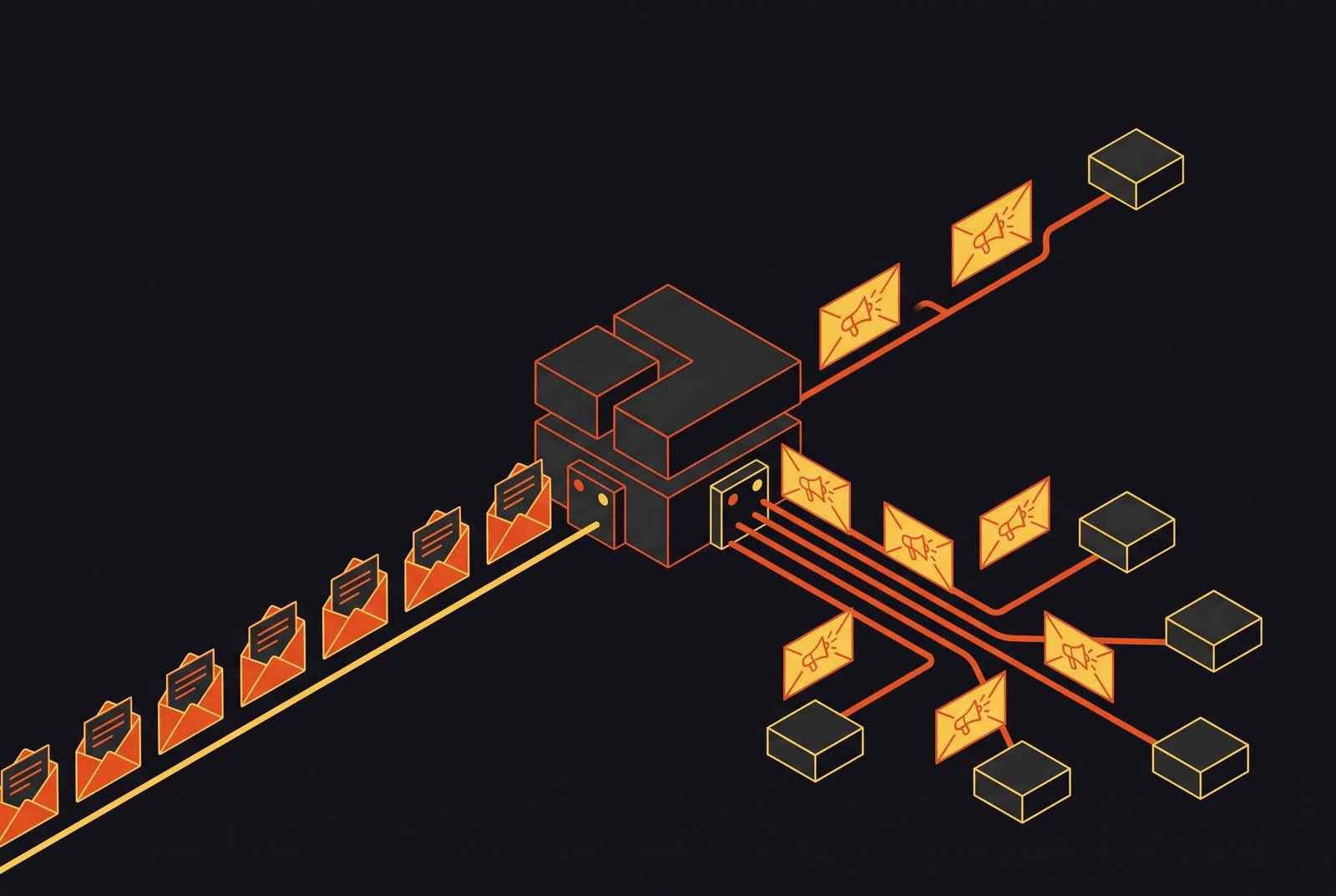
An AI agent that sends a receipt and an AI agent that sends a promotional campaign should be able to use the same email API, with one authentication context and one set of compliance rules, rather than two separate platforms stitched together at runtime. That's the architecture this piece argues for, and it's the reason transactional and marketing email are converging into a single API surface built for agents rather than for the human teams who used to manage each stream by hand.
Why email infrastructure split into two separate products
The split between transactional and marketing email was a reasonable answer to a set of constraints that no longer describe how these systems get used. Transactional email, the password resets, receipts, and login links that a product depends on to function, needed guaranteed delivery and its own IP reputation, with none of the compliance overhead that slows down a bulk send. Speed and reliability were the entire job. Marketing email ran on a different set of requirements entirely: list management, unsubscribe handling, compliance headers, audience segmentation. Those are two different operational surfaces, and keeping them apart protected the one that mattered most for product function. A spam complaint spike on a campaign wouldn't drag down the deliverability of a password reset, because the two lived on separate infrastructure with separate reputations to protect.
That separation worked because a human operator sat on each side of it. One team owned the transactional API and treated it as plumbing. The other team owned the marketing platform and treated it as a campaign tool. The boundary between the two was a decision a person made once, deliberately, when the architecture was first put in place. Nobody had to cross that boundary mid-task, because the two systems served two different jobs performed by two different people.
What changes when an agent owns the email workflow
An agent executing a single workflow doesn't get to pause at an API boundary the way a human operator moving between tools can. When a person switches from a transactional API to a marketing platform, that switch is a deliberate act: log in, configure, approve, and only then proceed. An agent doesn't work that way. Crossing that same boundary mid-task means picking up a second authentication context, a second error surface, and a second set of behavioral assumptions, all while trying to satisfy the first set it just left behind.
Agentic workflows run as one continuous process, replacing a chain of human handoffs. An agent can observe a trigger event, compose a message, select an audience, and dispatch a send within a single reasoning loop, start to finish in milliseconds. What separates this from older rule-based automation is that the logic adapts as it runs: the agent reads engagement history, generates content suited to the recipient, picks a send time, and sends, all in one pass, rather than executing a fixed script one step at a time.
But that continuity breaks the moment a workflow has to touch both stream types. A transactional confirmation followed immediately by an opted-in onboarding broadcast is a common enough pattern, and under split infrastructure the agent has to jump between two APIs, two authentication models, and two error vocabularies that have no guarantee of working together cleanly. An agent that can't complete a cross-stream action fails silently: it may retry the wrong thing, skip a step it shouldn't, or drop part of the workflow without surfacing any of it, because no human is standing between the trigger and the send to catch the mistake.
The practical cost of the split in an agentic context
The cost of that split isn't measured in developer annoyance. It causes deliverability damage the agent never sees coming, because the failure happens upstream of any signal the agent is built to watch for. Cross-API workflows multiply the places a silent failure can occur: a template variable that never renders, a suppression list that exists on one side of the split but not the other, or a missing List-Unsubscribe header on a message the agent routed through the wrong stream.
Suppression list drift is one of the more concrete versions of this problem. A contact unsubscribes through the marketing platform, and that suppression has no guaranteed path to the transactional API. The agent, operating across both systems, has no single consistent record of who should or shouldn't receive a message, because the two systems were never built to share that record.
Compliance status is also stream-specific under a split model, which puts a real decision in front of the agent every time a message blurs the line between the two categories. An onboarding email with a promotional element is exactly that kind of message, and the agent has to decide which API handles it. If you get that wrong, the message either loses compliance protections it needed or picks up marketing-stream overhead it didn't. That decision carries legal weight beyond the operational kind: the FTC's primary-purpose test treats the classification itself as the determining factor in which rules apply, so an agent routing a message through the wrong stream isn't just creating a mess, it's creating compliance exposure nobody authorized. Verkada's $2.95 million CAN-SPAM settlement in 2024 shows what that exposure can cost when it's left unmanaged.
Idempotency is the last piece, and it breaks in a way specific to split infrastructure. An agent retrying a failed send may have already dispatched the message through one API while the other has no record the send ever happened. To a mailbox provider, the result looks like a duplicate send pattern, and duplicate sends are the kind of behavior that triggers reputation scrutiny.
Why a unified API fits a single-agent workflow
A single API covering both streams is not just a convenience layer bolted onto the old split. It removes the mismatch between how an agent actually reasons through a task and how the infrastructure underneath it was organized decades before agents existed. When transactional and marketing sends share one API, the agent holds one authentication context, one error model, one suppression state, and one compliance surface for the entire task. Email becomes a single action space the agent can reason about directly, instead of two disconnected systems it has to reconcile on the fly.
The market is already moving this direction. Telnyx made the case explicit in 2026 when it launched an Email API that lets businesses send transactional and marketing email through the same REST API they already use for SMS, voice, and WhatsApp, treating single-API access as the natural endpoint for a communications platform.
Unifying the API doesn't mean collapsing the reputation boundary that made the original split worthwhile. Protecting transactional sends from a marketing complaint spike never required two separate APIs. It requires separate sending infrastructure underneath a single API surface, with the platform handling the routing logic mid-task. Platforms built from the ground up for agentic senders, among them GIC - Agent Send, remove the authentication-switching and error-vocabulary friction entirely because they combine both streams into one API, so the agent works within a single error model and a single suppression state no matter which type of message it sends, and can apply idempotency keys the same way across every send type instead of managing two separate idempotency schemes that were never designed to talk to each other.
Requirements for an API supporting agents across both streams
If you unify the API, it has to give the agent machine-readable control over both streams, so no person needs to interpret anything along the way. Typed error codes returned in structured JSON are one of the clearer requirements on this list, because an agent that receives a human-readable error string and nothing else will often guess at a retry path that doesn't exist, which is its own kind of silent failure. Most legacy providers don't meet this bar today.
Rate limiting needs to work the same way. Standard headers, Retry-After, X-RateLimit-Remaining, X-RateLimit-Reset, give an orchestrating agent something it can act on directly. Without them, the agent can't tell a soft limit from a hard block, and it has no reliable way to back off before it makes the problem worse.
You need pre-send linting at the API layer itself, not in the agent's own logic, because post-send monitoring only tells you about damage that already happened. A guardrail that catches a missing unsubscribe header, an unrendered template variable, or a send aimed at a suppressed contact before anything leaves the server is the only version of this that actually protects an autonomous sender. Compliance needs to default to on for the same reason: suppression list enforcement, List-Unsubscribe headers, and DMARC, DKIM, and SPF authentication should be applied by the platform without the developer having to configure any of it, because an agent can't fix a compliance gap it doesn't know exists. Scoped API keys, split by operation type between read, draft, and send, round this out by giving the agent only the permissions the task in front of it actually requires, which limits how much damage a mistake can do.
Silent failures like suppression list drift, compliance state fragmentation, and broken idempotency all demand infrastructure built to catch them before a message goes out, not after. GIC - Agent Send's pre-send guardrails intercept exactly these failures at send time and return machine-readable errors with specific fixes attached, so the agent can correct the problem on its own instead of needing a person to step in, and nothing malformed reaches a recipient's inbox.
How AgentSend implements the unified model
AgentSend is built around the position that an agent should never have to cross an API boundary to move from a transactional send to a marketing one. One API and one MCP server cover both: password resets, login links, and receipts on the transactional side, opted-in marketing broadcasts on the other, all through a single tool and a single authentication context regardless of which type of message is going out.
Compliance on AgentSend isn't something a developer turns on. Suppression list enforcement and List-Unsubscribe headers work as platform guarantees rather than configurable settings, so the agent never has to make the compliance-classification call, and that call is the exact judgment that creates legal exposure under the FTC's primary-purpose test. AgentSend also draws a firm line at the platform level against cold outreach: only product email and opted-in marketing are supported, a boundary that protects the sender's reputation from the abuse patterns that autonomous sending could otherwise make far too easy to produce at scale.
Putting a unified agent API into production without breaking deliverability
If you move to a unified API, you still have to rebuild the deliverability protections the old split used to provide through separation, explicitly, at both the platform level and the agent's own configuration. Domain setup comes first and applies before any agent sends a single message: SPF, DKIM, and DMARC all need to be in place, because mailbox providers treat these as baseline requirements rather than nice-to-haves, and a unified API doesn't get an exception.
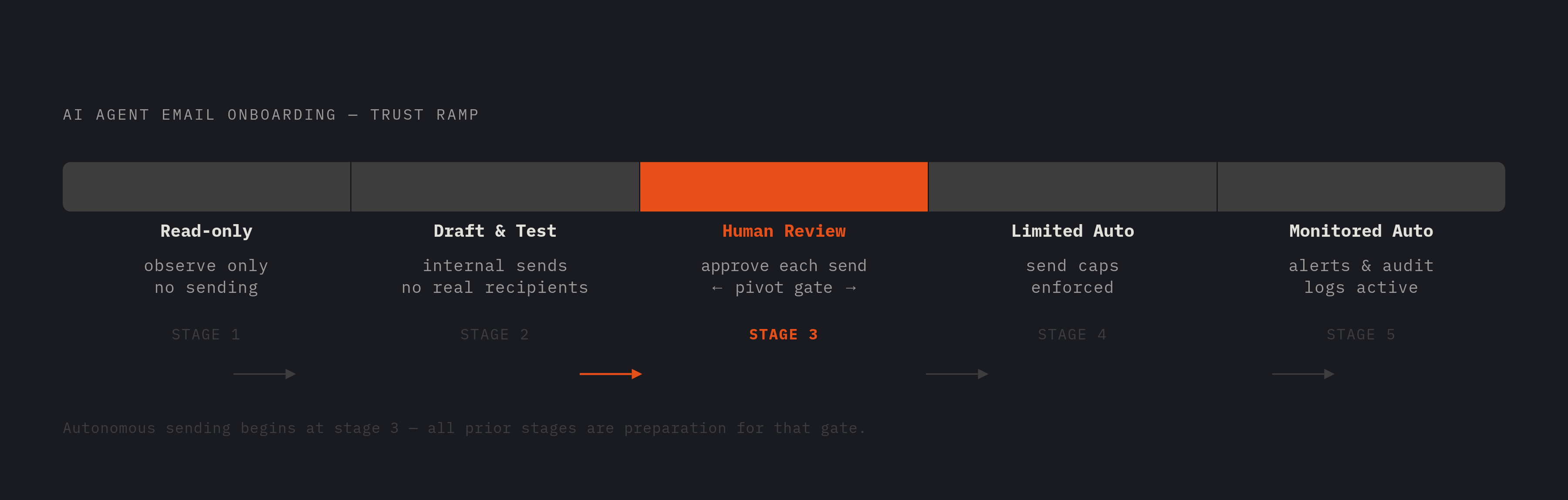
Stream routing still matters inside a unified API, even once both message types share the same surface. Transactional sends and marketing broadcasts should still move through logically separate sending infrastructure, separate subdomains or separate IPs, so a complaint spike on one campaign doesn't touch the deliverability of a password reset running through the same API. Staged access is the safest way to bring an agent onto this kind of system: start with read-only access, move into draft mode and test sends, progress to approved sending with a human reviewing output, then to limited autonomy under send caps, and finally to monitored autonomy with alert thresholds and audit logs in place. A unified API makes this progression easier to enforce consistently, because one permission model governs the whole path instead of two separate ones you have to keep in sync by hand.
Idempotency keys belong on every transactional request without exception, and any agent still being tested against a simulator address should be confirmed to handle a refusal correctly before it's handed production send access. New sending domains still need a warm-up period before they can carry production volume. A unified model doesn't remove that requirement, it just means the warm-up applies to a single domain identity instead of two separate ones that both needed their own ramp. And inbox placement today is driven less by open rates than by engagement signals, replies, clicks, continued conversation, all of which mailbox providers' filters now weight heavily. An agent optimizing purely for send volume, without watching those signals, is building toward a reputation problem one send at a time, regardless of how clean the API underneath it is.