Pre-Send Linting Architecture for Agentic Email Systems
Agents send email faster than humans can review it, so validation must happen before delivery.

Pre-send linting and guardrails for agentic email must intercept every outbound message before delivery, validate rendering, compliance and content integrity, and return machine-readable fixes when checks fail. People cannot review messages as fast as agents send them, so the infrastructure must enforce validation even when an application wrapper is optional.
Why human-gated email review breaks down when agents are sending
Email infrastructure was designed around a human operator who composes, reviews and approves each send. Agents do those steps in milliseconds, with no natural pause to check the message between writing and delivery. The risk changes in both kind and speed. A misconfigured template or missing compliance header can reach thousands of inboxes before a person notices, while the sending system continues to treat delivery as success.
Silent failure is the defining hazard here. A literal {{first_name}}, a missing unsubscribe link or a retry loop producing duplicates need not generate an immediate error visible to a human. Instead, the consequences accumulate in bounce rates and spam complaints. Domain reputation absorbs the decisive damage because the From identity remains constant while sending behavior looks automated, making recovery slow and expensive. With the human review gate removed, validation must be mechanized before the send call reaches the provider.
What pre-send linting actually is and where it sits in the pipeline
Pre-send linting is an interception layer between the agent’s send instruction and the delivery call to the email provider. It belongs to the broader category of guardrails, but its responsibility is specific. The layer receives the full message payload, including recipient, subject, body, headers and template variables, and runs each against a rule set. A passing message proceeds to delivery. A failing message returns to the agent’s orchestration logic with a structured description of the problem and its fix.
That placement distinguishes linting from post-send monitoring. A bounce report or spam complaint comes after a send has reached or tried to reach a recipient, while linting checks the message before delivery. The response format therefore belongs in the architecture from the start. Since an agent must act on the result, a string such as “unsubscribe link missing” leaves recovery dependent on additional interpretation logic. A machine-readable response gives the runtime a defined outcome it can handle before authorizing another send attempt.
How do you prevent broken merge tags and missing unsubscribe links before sending?
Template rendering checks must look in both the subject and the body for unresolved variables, including literal {{variable}} and [[variable]] tokens. Any remaining token should block the send. The body must also contain actual content rather than a skeleton of merge tags without resolved values. The subject must be present and non-empty, because an empty subject is both a deliverability signal and a user-experience failure.
Marketing and broadcast messages need a functional unsubscribe link in the body, and validation must check that the List-Unsubscribe header is present and correctly formatted. Gmail and Yahoo’s 2024 sender requirements make one-click unsubscribe mandatory for senders exceeding 5,000 messages a day. Physical mailing addresses or legally required sender identification must also appear where applicable.
Link validation must check that every href points to a valid destination other than localhost or a staging address, and flag redirect chains that end on error pages. Recipient checks must reject structurally invalid addresses and consult the current suppression list at send time. Known hard-bounce addresses must be suppressed at once and stay suppressed for good. Inline images must have alt text for accessibility and spam scoring. These checks are independent, so success on one cannot compensate for failure on another.
How the linting layer should surface errors back to the agent
A lint failure must identify what failed and what recovery is appropriate. The response should be structured JSON with a typed error code, the affected field or element, and a specific remediation instruction. For example, an error object can use error with value UNRENDERED_VARIABLE, field with value body, token with value {{first_name}}, and fix with value resolve template variable before send. Those fields expose the defect without requiring the runtime to infer it from a sentence.
Typed codes let orchestration branch deterministically. A MISSING_UNSUBSCRIBE_LINK response needs a different recovery path from SUPPRESSED_RECIPIENT, and whether the result is a blocking error or a warning also decides whether sending can go ahead. Warnings should be logged, but blocking errors must stop delivery. The orchestration layer must read and validate those outcomes itself, rather than merely place them in the model’s context window. Otherwise, a model can report “email sent” even when the tool returned an error.
Idempotency and retry logic as linting concerns, not afterthoughts
Retries are normal behavior in agent runtimes. Without idempotency at the send layer, however, a repeated tool call can dispatch a duplicate indistinguishable from the original. Each send should therefore use a deterministic idempotency key derived from its triggering event. When the same key arrives again, the linting layer should resolve the call to the same message record. Its response should tell the agent, in machine-readable form, why the repeated call was absorbed.
This enforcement belongs upstream of delivery, where duplication can still be prevented. Post-send monitoring cannot retract a duplicate that has already left the system. Nor is application-only deduplication sufficient when a second code path can call the API directly and omit it. Autonomous retries can also compound a temporary failure by sending too quickly, slightly changing content or continuing to target suppressed addresses. Enforcing idempotency and suppression at the send layer keeps retries under the same rules as the first attempt.
Server-side enforcement as a backstop when application-layer checks are bypassed
An application wrapper protects only the paths that invoke it. A second code path, a retry that skips the wrapper or a new endpoint without validation removes that protection. The infrastructure must therefore enforce rules after application handoff but before provider delivery. A message that fails a blocking rule must be rejected there, regardless of which application route initiated it. The wrapper can assist the agent, but it cannot serve as the final authority.
This is the architectural distinction between purpose-built agentic infrastructure and a wrapper around a conventional email service provider. A conventional API has no native concept of an agent-side lint step, so checks placed solely in application code remain bypassable. Server-side enforcement makes validation independent of that routing choice. The same boundary should enforce address and domain denylist rules, rejecting prohibited recipients on every send path. This does not require assuming the orchestration logic is correct.
Compliance defaults that must be on by default, not manually configured
An agent given credentials to a sending domain will not independently configure unsubscribe headers, suppression integration or DMARC alignment. If setup must be done by hand, autonomous sending depends on work outside the send path. Compliance must therefore be an infrastructure default. A broadcast sent without the required one-click unsubscribe support violates the mailbox provider’s requirement regardless of whether the developer knew to configure it. Suppression must be equally automatic, with hard bounces suppressed immediately and permanently and spam complaints triggering an instant stop.
Domain authentication must be set up correctly before sending starts. The configuration should use one SPF record per domain, because two v=spf1 records cause SPF to fail outright. DKIM should sign with the sender’s own domain rather than the provider’s shared domain, while DMARC should progress from p=none monitoring through quarantine to reject as alignment is confirmed. A technically passing signature for the provider’s domain is not a substitute for the sender’s own identity. These setup requirements go hand in hand with per-send compliance validation, which must keep running after the one-time work of following the documentation is done.
Domain isolation and reputation management for agentic senders
Per-message validation cannot fully protect an architecture that places autonomous traffic on the same sending domain as critical transactional or human email. Agentic sends should use a dedicated subdomain such as agents.yourcompany.com. This separates the agent’s sending identity from the primary domain’s password resets, login codes and receipts. Mailbox providers learn the subdomain’s behavior independently of the parent domain. That separation keeps critical mail safe when the volume or patterns of automated sends harm the agentic subdomain’s reputation.
Bounce rates and spam complaints remain constraints on sending behavior, and linting protects those rates by rejecting recipients already known to be unsafe to contact. The suppression list must therefore use provider feedback without waiting for a person to update it. An agent will not pause to process a bounce report, and checking an old list cannot provide a reliable backstop.
How MCP tooling changes the integration model for linting
An MCP server gives agents a typed tool schema through which to interact with email infrastructure. Structured lint results can fit straight into the tool-call response format without a custom layer to interpret them. A native server also lets agents find operations such as lint-and-send without a separate adapter. Agent frameworks with MCP tool support can use the same typed interface. Scoped MCP OAuth credentials should grant send permissions without administrative permissions, keeping the linting rules outside the sending agent’s control.
A developer-maintained or community-built adapter may not expose typed lint results, has no maintenance guarantee and can drift from the underlying API. Native MCP tooling makes that interface part of the infrastructure, but server-side validation is still where the rules are enforced. AgentiSend’s site documents error responses in which every 4xx and 5xx includes code, message, fix, docs_url and retryable, as well as POST /emails/preflight for running checks without sending. A preflight call alone, however, is not a substitute for checks enforced on the final send path.
Putting it together — the linting pipeline in a real agentic send workflow
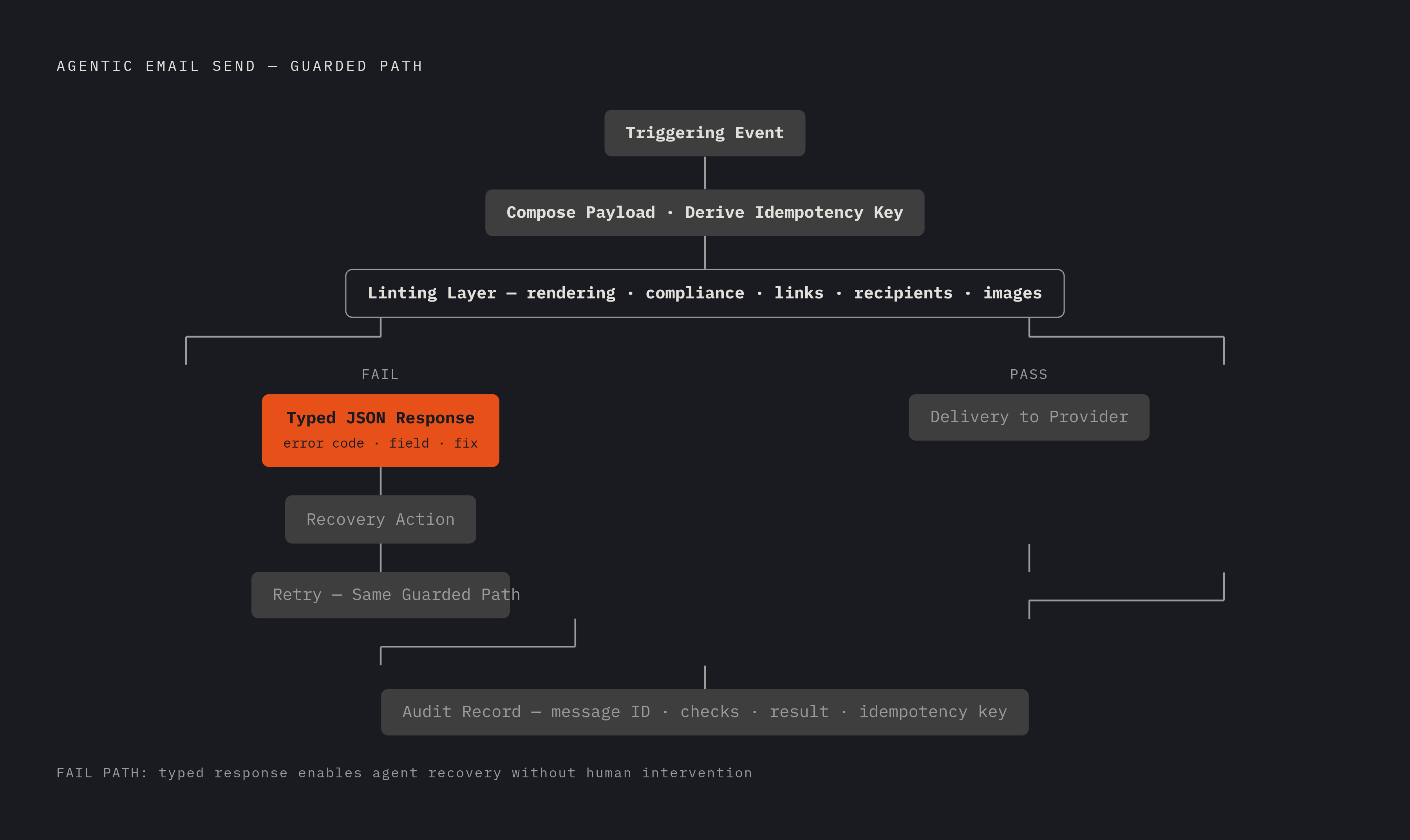
A production workflow begins with a triggering event, followed by the agent composing the message payload and deriving an idempotency key from that event. The linting layer then intercepts the payload and runs the rendering, compliance, link, recipient and image checks. Delivery follows only after a passing decision. A failure returns a typed response to the orchestration logic, where a specific recovery action handles the defect. For MISSING_UNSUBSCRIBE_LINK, that means adding the link and retrying through the same guarded path.
Every decision should produce an audit record. It should include the message ID, recipient, checks performed, each check’s result, idempotency key and final outcome, giving the team a basis for debugging sends that no person watched. As sending moves from supervised to autonomous, a small group of real subscribers should get agent emails first so the team can check lint pass rates and message quality before sending at full volume. This canary pattern tests the workflow without requiring a person to approve every message from then on.
AgentiSend’s pre-send guardrails layer exemplifies enforcement implemented as infrastructure, intercepting malformed or non-compliant sends and returning machine-readable errors with specific fixes. The decisive property is coverage of every send path. Typed responses make recovery possible, idempotency constrains retries, and suppression connects delivery feedback to the next decision. Together, these requirements establish the governing principle. Pre-send linting is not a feature added to an email API, but the design constraint that distinguishes infrastructure built for agents from infrastructure adapted from human tooling. Some platforms are emerging specifically around this constraint, such as GIC - Agent Send, a transactional and marketing email platform built for autonomous agent workflows that lints every outbound message for unrendered variables, compliance gaps, and suppression failures before anything reaches the provider.