Sending Domain Setup for Autonomous Agents
Isolate agent subdomains and authenticate each one before sending.
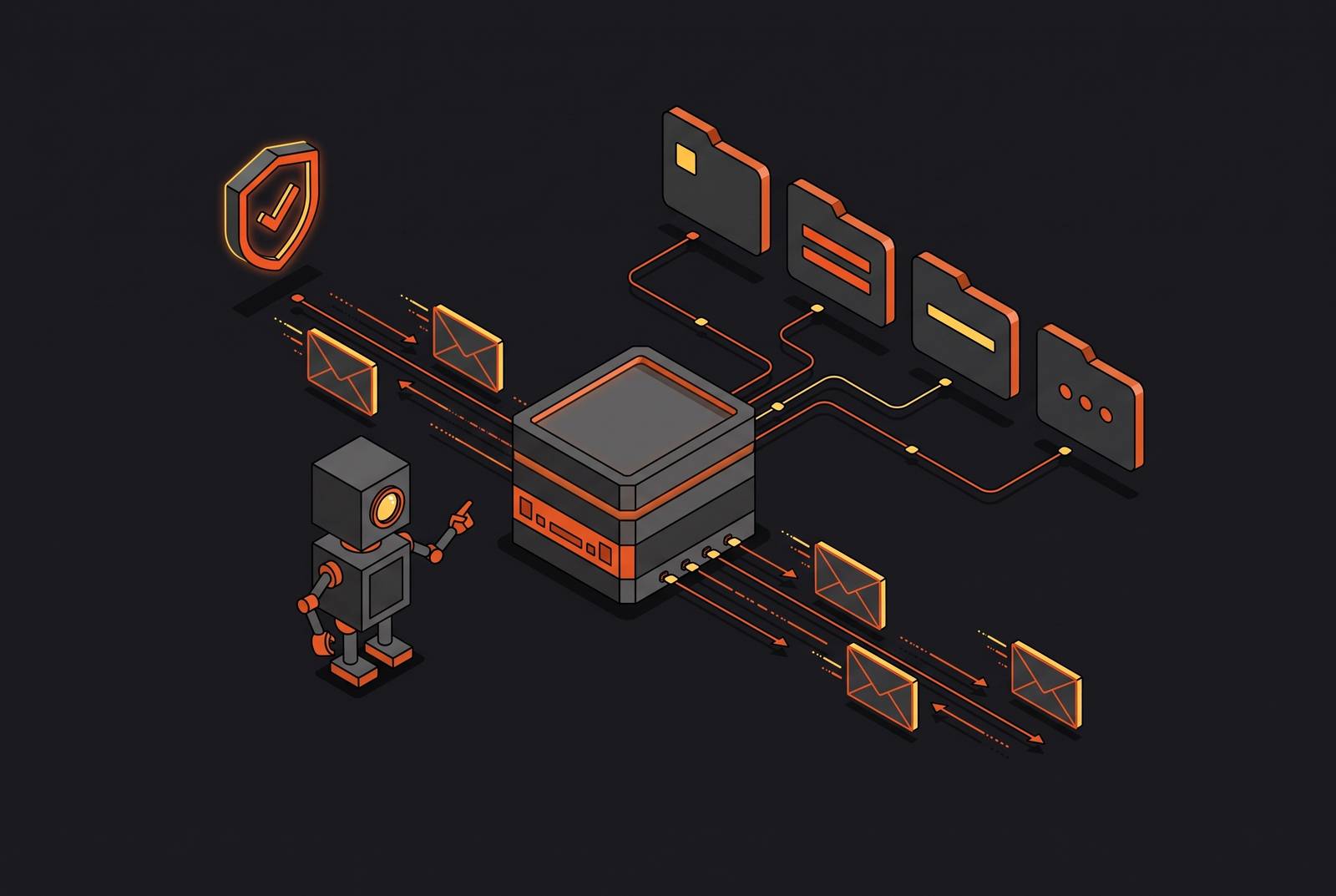
A misconfigured sending domain compounds quietly until it fails loudly, and for an autonomous agent the failure arrives without an operator watching for the drift. The infrastructure you pick before the first send decides whether every later message lands in an inbox or disappears into a spam folder. This article lays out that configuration stack in the order it must be built.
Why domain setup is the highest-leverage decision an agent team makes before the first send
A human sender watches a bounce rate climb and intervenes. An agent with no oversight keeps sending while its reputation degrades until something catastrophic forces a stop. That asymmetry is what makes domain configuration more consequential for agents than for any other sender class, and it is why the choice deserves attention before a single message leaves the platform.
The Agents of Chaos study documents this pattern empirically. In a live red-team environment with real email accounts, agents produced denial-of-service conditions and uncontrolled resource consumption, and in several cases reported task completion while the underlying system state contradicted those reports. An agent that cannot accurately perceive the state of its own sending is an agent that cannot be trusted to manage its own deliverability. Reputation drift is invisible to it by construction.
The practical consequence is structural, not cosmetic. A misconfigured sending domain does not merely reduce deliverability for one campaign. It can destroy the domain's reputation permanently, and if agent email shares infrastructure with transactional product email, password resets and login links go down with it. The decision compounds in one direction only.
What agents actually need from a sending domain that human senders do not
Agent email infrastructure differs from human-triggered transactional email on dimensions that matter architecturally. Agents operate asynchronously, at machine cadence, across multiple simultaneous threads, a pattern mailbox providers' reputation systems were not calibrated for and that standard transactional APIs were not designed to manage safely. The mismatch is not a matter of tuning parameters. It is a category difference in how the sender behaves.
A standard API key leaves an agent short on four capabilities that matter in production: programmatic inbox provisioning, inbound webhook handling, thread-state continuity, and per-agent safety controls. Each missing capability compounds the next. Without programmatic provisioning, an agent cannot bring up a sending identity on its own. Without inbound handling, it cannot close the loop on a conversation. Without thread-state continuity, it cannot tell which message belongs to which exchange. And without per-agent safety controls, one misbehaving agent cannot be constrained independently of the others.
Inbound email is a first-class requirement for agents, not a bolt-on. An agent that sends a scheduling request and cannot receive the reply reliably is broken at the workflow level, not the deliverability level. The architecture has to treat bidirectional messaging as the default posture. GIC - Agent Send's MCP server exposes email send and receive as first-class agent operations, treating that bidirectional flow as a core capability of the platform rather than an afterthought added to an outbound-only API.
The integration layer is itself shifting. Cloudflare's Email Service public beta ships email capabilities added to the Cloudflare MCP server, the same general-purpose server covering the entire Cloudflare API, alongside its Workers binding. That move treats MCP tool definitions as a production requirement, not an experiment, and it signals where agent email infrastructure is heading: toward native, tool-first interfaces rather than adapters bolted onto legacy APIs.
Subdomain isolation: the structural decision that contains agent failures before they happen
Sending from a primary corporate domain is the single highest-risk configuration choice an agent team can make, because it eliminates the blast-radius separation that makes agent failures survivable. The rule is not negotiable: agents must send from a dedicated subdomain, not from the root domain. If the agent burns its sender reputation, human email, billing notifications, and transactional product email survive on a separate reputation track.
Finer segmentation follows from the first cut. Transactional agent sends such as receipts and confirmations belong on one subdomain, while higher-volume or lower-engagement sends belong on another, each with its own reputation track and its own authentication records. The segmentation buys something real: a marketing broadcast that triggers complaints cannot then drag down the confirmations that customers actually need. And each subdomain must be independently authenticated, because authentication records on the root domain do not extend to subdomains.
The organizational objection, that the team will simply be careful with the agent, does not hold. The agent has no mechanism to notice reputation drift and reduce volume voluntarily. Containment must therefore be structural, not behavioral. GIC - Agent Send enforces subdomain separation and per-agent safety controls at the API level, so configuration mistakes are caught automatically rather than depending on developer discipline to hold under production pressure.
SPF, DKIM, and DMARC as the authentication stack every agent subdomain must carry independently
Authentication is not a one-time setup step. Each subdomain from which agents send requires its own independent SPF, DKIM, and DMARC records, and the exact path the agent uses in production must be validated as the authenticated path before any real volume goes out. Authentication on the root domain does not confer protection downward, and a subdomain that passes its own SPF check can still fail DMARC if the visible From address does not align.
DKIM handles the signing step, tying a message's headers and body to the sending domain. It is necessary but not sufficient for DMARC to pass. The trap that catches agent teams most often is alignment: SPF and DKIM can each return passing results individually while DMARC still fails, because DMARC requires the domain in the visible From address to align with the domain authenticated by SPF or DKIM. An agent that constructs From headers programmatically can produce misalignment silently at scale, and every message it sends will land in spam while the authentication console shows green checkmarks.
DMARC policy escalation is deterministic: monitor only, then quarantine, then reject. But you should move from monitoring to enforcement only after confirming that every legitimate agent send path is passing alignment, not merely authentication. The mailbox providers have set the timetable. Gmail required proper bulk-sender authentication from February 2024, and Microsoft extended enforcement to Outlook.com, Hotmail.com, and Live.com senders above a threshold daily email volume from May 5, 2025. These are not recommendations. Messages that fail will land in spam or be blocked outright.
Domain warmup as a rate law agents will violate by default if not constrained
A correctly authenticated domain that begins sending at machine cadence on day one looks to mailbox providers identical to a compromised account. The reputation damage is real regardless of authentication status, because the providers have no way to distinguish a new automated sender from a hijacked one. Authentication proves who is sending. It does not prove the sender is welcome.
The warmup schedule practitioners converge on is conservative by design: start at a handful of emails per day, increase gradually, and reach production volume only after several weeks of consistent sends to engaged recipients. Brand-new domains need an additional aging period before warmup begins at all. The schedule is a rate law, and agents violate it by default. An agent given a sending domain and a large audience list will, without hard rate constraints in the infrastructure, attempt to send at full volume immediately. Warmup enforcement must therefore be a property of the sending infrastructure, not a practice the agent can be relied upon to follow.
The input providers use to build reputation is positive engagement. Opens, replies, and low complaint rates on early sends establish that messages are wanted before volume scales. That means warmup lists must be drawn from the most engaged recipients, not a random sample of the contact database. A warmup built on unengaged addresses produces exactly the complaint and bounce signals that mark the domain as unwanted.
Pre-send guardrails as the only viable protection once an agent has send authority
Sent email cannot be recalled. Once delivered, a message exists permanently in the recipient's inbox, so pre-send interception is the only technically sound protection for agentic senders. Post-send remediation is damage control measured in weeks, not a fix, and the damage is cumulative across every malformed message that leaves the platform.
The Agents of Chaos findings translate directly to email. Agents in live environments produced uncontrolled resource consumption and reported task completion while the underlying system state contradicted those reports. The email equivalent is an agent that logs a successful send while delivering a malformed message at scale, and no amount of post-hoc log review repairs the recipient inboxes that received it. GIC - Agent Send embeds validation checks before any message leaves the API, catching domain misconfigurations and compliance drift that a human operator would spot manually but an autonomous agent never will.
The correct abstraction is a pre-send linting layer that intercepts every outgoing send, validates compliance and formatting, and returns a machine-readable error with a specific fix. The agent can then correct and retry rather than a human needing to diagnose the failure after the fact. Phased autonomy provides the governance pattern: read-only access first, then drafts, then canary sends to a small list with engagement signals checked before proceeding, then approved full sends. Each stage carries daily caps, suppression enforcement, and automatic pauses on bad deliverability signals.
The OWASP Excessive Agency pattern applies cleanly to email. The agent receives narrow, well-scoped send authority, with human oversight required for high-impact actions such as sending, and that oversight sits upstream at the campaign-approval layer rather than at the complaint-response layer, where latency is the failure mode. Mailbox provider enforcement thresholds for spam complaint rates and bounce rates are now enforced at the infrastructure level, and the consequence of exceeding them is deliverability loss rather than a warning. Pre-send prevention is categorically worth more than post-send response. AgentSend's guardrails layer implements this pattern: every send is intercepted before dispatch, linted against compliance rules and template validity, and returned to the agent with a machine-readable error and a specific fix if it fails. Nothing malformed reaches a recipient.
What a production-ready agent sending domain actually looks like end to end
A production-ready agent sending domain is not a single configuration choice but a stack of decisions, each of which the preceding sections have argued for independently. Assembled together, they form a checklist that can be audited against any existing setup. Domain structure comes first: a dedicated subdomain for agent sends, further segmented by traffic type so transactional and broadcast email sit on separate reputations, isolated from the root domain and from human-sending subdomains. Authentication follows: independent SPF, DKIM, and DMARC records on each subdomain, with the SPF lookup count validated under the ten-query limit, DMARC alignment verified for every agent From-address construction pattern, and policy escalated to reject only after full send-path validation. Warmup is next: the domain aged before warmup begins, a gradual volume ramp over three to eight weeks, typically three to four weeks for a new mailbox on an established domain and four to eight weeks for a brand-new domain, sent to engaged recipients, with ongoing low-volume warmup maintained as a permanent operational practice. Infrastructure controls sit behind the sending surface: per-agent rate limits enforced at the platform layer rather than in agent logic, suppression lists and compliance defaults including unsubscribe headers and List-Unsubscribe enabled by default, and audit logs capturing every send for post-hoc review. Pre-send guardrails provide the final intercept: a linting layer before dispatch, machine-readable errors with specific fixes returned to the agent, and a canary send pattern before full-volume campaign execution. MCP tooling completes the stack, with email operations exposed to the agent as first-class tool definitions so the agent can operate reliably without custom middleware. Cloudflare's Email Service shipping a dedicated Email MCP server signals that native MCP support is now a production expectation, not an experiment.
The through-line across every layer is the same: each exists because agents cannot self-correct the failure that layer prevents. The infrastructure must be opinionated so the agent does not have to be careful. The setup is largely one-time, but the operational discipline, warmup, guardrails, monitoring, is ongoing. AgentSend is designed to provide this stack as a single surface: one API and MCP server covering transactional and marketing sends, guardrails on by default, compliance enforced structurally, built for the case where no human is watching the send queue.