How a Single Email API Endpoint Collapses Agent Decision Trees at Send Time
One email endpoint removes the infrastructure branches that trip up agents.
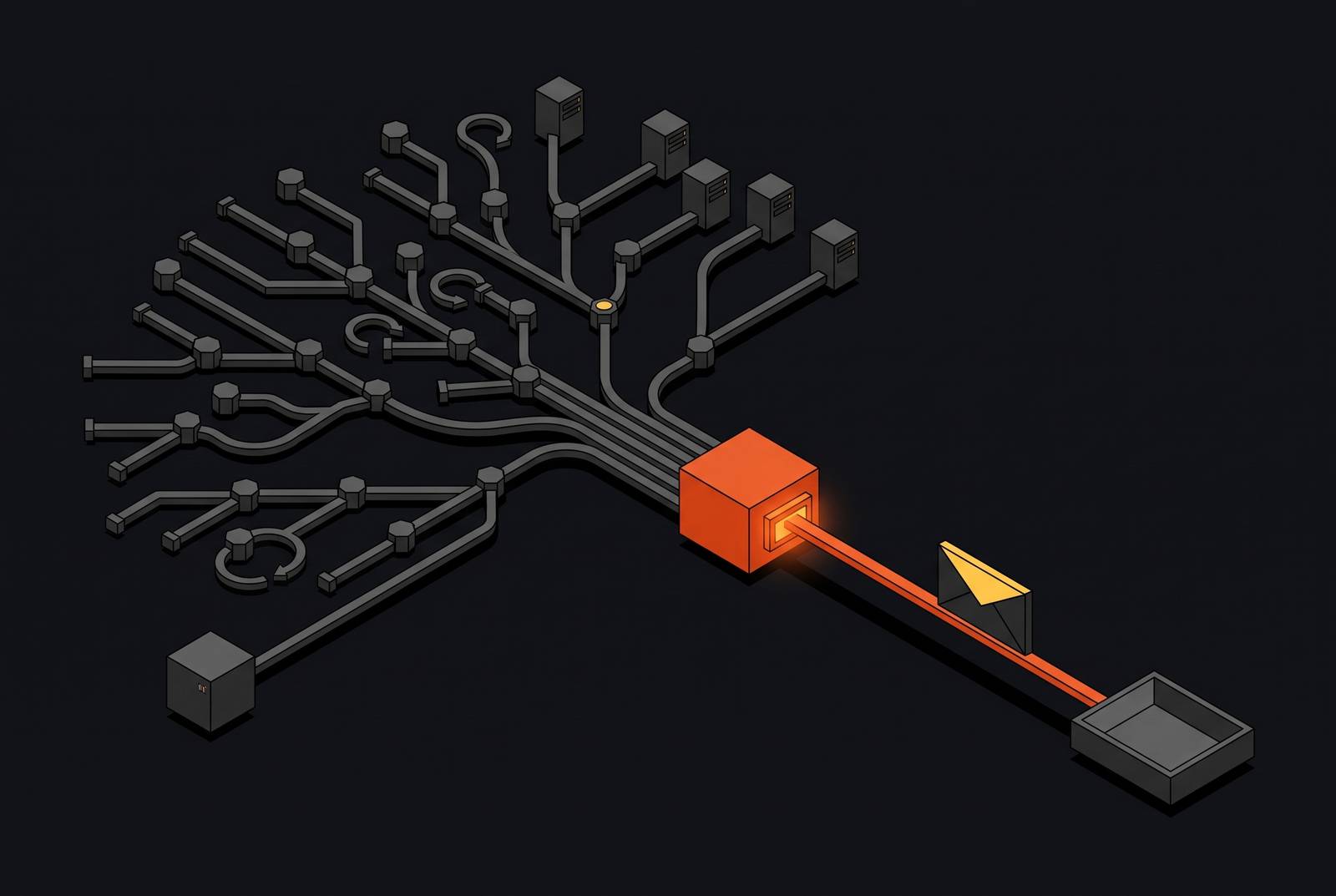
A unified transactional and marketing email API for AI applications should let agents send receipts and newsletters through one interface without having to choose a separate service for each message. The reliability gain comes from moving credential handling, transport, delivery feedback, and safety controls into infrastructure.
Why email send logic is harder for agents than for humans
A developer selects credentials, configures transport, completes domain verification, and returns when something breaks. OAuth flows, SMTP host and port settings, and TLS negotiation assume that human setup and recovery are available. An autonomous agent cannot count on a human to do that work. Unless the surrounding system resolves those questions, they become live conditions the agent must interpret while performing its actual task.
Recovery creates the sharper distinction between the two models. A human who stops receiving replies can investigate, refresh a token, or change course after a soft error. An agent without explicit bounce or complaint signals can keep sending, compounding the original problem. Alternatively, it can stall because it has no defined recovery path. Its decision tree then includes authentication, transport selection, credential expiry, and reply routing, although none belongs to the task that prompted the message. These branches are artifacts of infrastructure designed around human operators.
What a decision tree branch actually costs an agent at send time
Every infrastructure branch consumes context and introduces another failure surface. The agent must distinguish a valid OAuth token from one needing refresh, select the applicable SMTP settings, and check that replies will return to the correct workflow. A failed request adds another question about how to handle a 429 or 550 response. Each decision can produce an incorrect branch, a loop, a stall, or a hallucinated retry path.
The AE4E working paper identifies “cascading failures” as a bottleneck in agentic systems, with upstream errors propagating through multi-step workflows. A misconfigured send path fits that structural pattern because later actions can depend on successful delivery or a returned reply. The paper also notes that one agent plans, executes, and evaluates its own actions, which it calls Logic Monopoly. Its diagnosis is a non-peer-reviewed working-paper argument. Applied to email, it explains why assigning transport management to the same agent creates compounding responsibilities precisely where an external action must be executed reliably.
How can AI agents send receipts and newsletters through one well-formed endpoint?
A shared interface removes the platform-selection branch only if the infrastructure behind it owns the send mechanics. The agent submits one HTTP POST with typed parameters, while the service resolves credential state, transport selection, TLS, and delivery confirmation. SMTP hosts, ports, handshake management, and relay credentials leave the agent’s code path.
API-key authentication removes a more specific branch. Unlike an OAuth integration that requires token refresh, the request presents a credential that is valid or invalid, and a typed response communicates the result. A failed credential still requires handling. The model need not invent a refresh procedure or infer what an ambiguous response means. Similarly, structured delivery feedback gives the system around the agent a clear result so the agent does not have to work out what happened from transport behavior.
Threading belongs behind the same boundary because it is another source of unnecessary state. When infrastructure processes In-Reply-To and References headers, the agent need not reconstruct email thread relationships in its own context. Handling inbound delivery through the same API also keeps the agent from needing a separate integration to find replies and read raw MIME after it sends a message.
The three inbound delivery modes and which agent architectures each fits
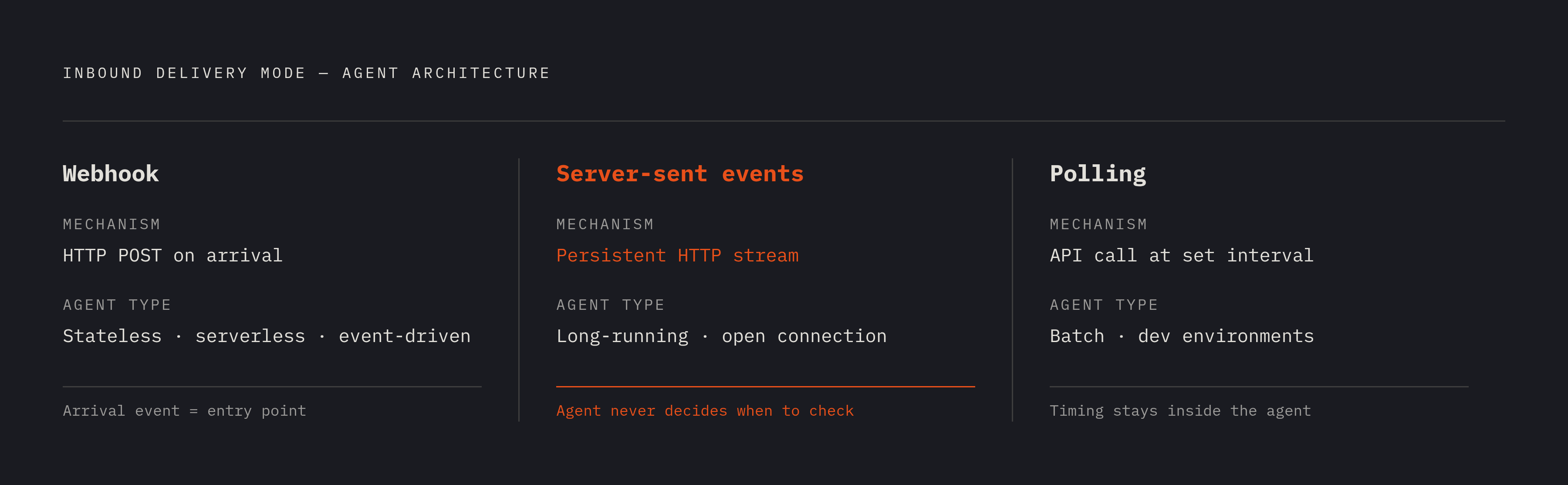
An API that leaves replies to an unrelated polling loop or manually configured webhook pipeline has removed only part of the branching. Webhooks deliver an HTTP POST to the agent’s endpoint when a message arrives, fitting stateless, serverless, and event-driven agents. The arrival event becomes the entry point to its next task.
Server-sent events, or SSE, provide a persistent HTTP stream for long-running agent processes that maintain an open connection. This removes the model’s decision about when to check, with connection handling belonging outside its reasoning path. Polling instead makes API calls at set times and fits batch-oriented agents or development environments where persistent connections are unavailable. Here, timing remains an explicit part of the workflow. The architectural test is whether these modes can fit the agent without requiring it to reconfigure credentials, select new endpoints, or reconstruct thread state whenever the inbound path changes.
What MCP servers do to the remaining branch between the LLM and the email endpoint
A well-formed endpoint does not guarantee a well-formed model-generated request. An LLM constructing HTTP calls can invent parameter names, omit required fields, or misroute a request. A Model Context Protocol server helps the model make those requests by giving it named tools with typed JSON schemas. Tools such as send_email, read_inbox, reply_to_thread, and search_messages give the model fixed call structures to use in place of a raw HTTP interface. The request goes through validation before it reaches the email API.
That moves schema errors to the tool layer. The model produces a structured function call, while the MCP server validates it and connects it to the email operation. Native MCP support also avoids requiring a team to maintain its own wrapper across agent framework updates and provider API changes. Agent skill definitions and CLI tooling serve a similar integration purpose for coding agents. These tools keep request construction from recreating the branches that the endpoint removed.
Autonomous provisioning as the precondition for endpoint simplicity to hold at scale
Send-time autonomy depends on how the sending identity was created. If every inbox requires a person to configure credentials, complete OAuth, or perform manual account setup, a simple endpoint has deferred the operational burden. Programmatic inbox creation moves identity provisioning into the system building or running the agents. A dedicated mailbox per agent or role then provides an isolated identity and sender reputation. Shared inboxes weaken that boundary through ambiguous reply routing, forwarding-rule noise, and credential dependencies.
Provisioning also needs its own abuse controls. Autonomous account creation cannot mean unrestricted access to sending, because the same ease of creation that supports agents can support abuse. Atomic Mail uses a computational challenge and reputation scoring as its anti-abuse mechanism. That illustrates a distinct responsibility at the provisioning boundary. The send interface cannot compensate for an identity-creation path that has no independent controls.
Deliverability rules that apply to every agent sender and cannot be delegated to the agent
Email authentication is still required when there is a single send interface. SPF, DKIM, and DMARC remain infrastructure responsibilities, as do bounce handling and complaint monitoring. Complaint-rate limits apply regardless of whether a human or an agent generated the message. Because an agent may not recognize soft failures, a poorly scoped workflow can breach those limits before a person notices. The feedback must therefore reach the system as explicit signals.
A dedicated subdomain keeps agent sending reputation separate from marketing and transactional domains, and provisioning settles that choice for subsequent sends. A unified API need not imply a shared sending stream. Receipts, newsletters, and agent correspondence can share an interface while retaining the infrastructure boundaries appropriate to their roles.
On free or developer tiers, a poorly behaved tenant can affect other tenants’ inbox placement. The agent cannot see that shared reputation or take another branch at send time to deal with it. Infrastructure selection is the available lever.
Safety controls that belong in the infrastructure layer for the same structural reason
The same separation applies to abuse prevention and governance. An agent with unrestricted send access can exceed safe volumes, generate complaints, or be redirected through prompt injection before a human intervenes. Asking that agent to police its own sending leaves enforcement inside the component whose behavior needs constraining. The control must exist independently of the model. Otherwise, every send depends on the agent correctly interpreting both its task and the limits on its authority.
Scoped credentials isolate agent identity, while rate limits bound the damage from a runaway or compromised workflow. Immutable logs support attribution after an incident, and loop detection catches runaway feedback cycles. Anomaly alerting and automatic suspension provide further controls outside the agent’s discretion. The AE4E paper frames this separation as Separation of Power, with adjudication structurally distinct from execution. Its “Security Permeability” bottleneck encompasses prompt injection, identity spoofing, and protocol-level integrity failures, all relevant when an agent can initiate external messages.
Agent-generated cold outreach to unverified lists belongs in an approval queue, while routine transactional messages to verified opt-in users do not require the same friction. Infrastructure enforces that distinction rather than asking the model to reconsider it on every request. Rate-limit headers also make recovery explicit for the orchestrator. Retry-After, X-RateLimit-Remaining, and X-RateLimit-Reset allow programmatic handling of retries.
What the remaining branches look like after the infrastructure absorbs the rest
The agent still has consequential decisions to make. It chooses message content and recipients, determines when sending fits the task sequence, and evaluates whether a reply changes the next action. Those decisions require its understanding of the workflow. Selecting a transport protocol, refreshing credentials, and reconstructing thread relationships do not. The boundary is therefore not between a system with branches and one without them, but between task decisions and infrastructure decisions.
A 401, 429, or 550 response still needs a defined handling path, but the model no longer has to invent one from transport details. Similarly, an inbound message still needs to be routed, but the agent need not check whether it has a channel to receive it. Simplicity in the agent’s decision tree is a reliability property because its remaining failure modes are tied to the task, rather than compounded by infrastructure decisions on every send.