The Email Infrastructure Decisions Teams Make When an AI Agent Owns Every Step From Trigger to Thread
Agents need limits and safety controls enforced outside the prompt.

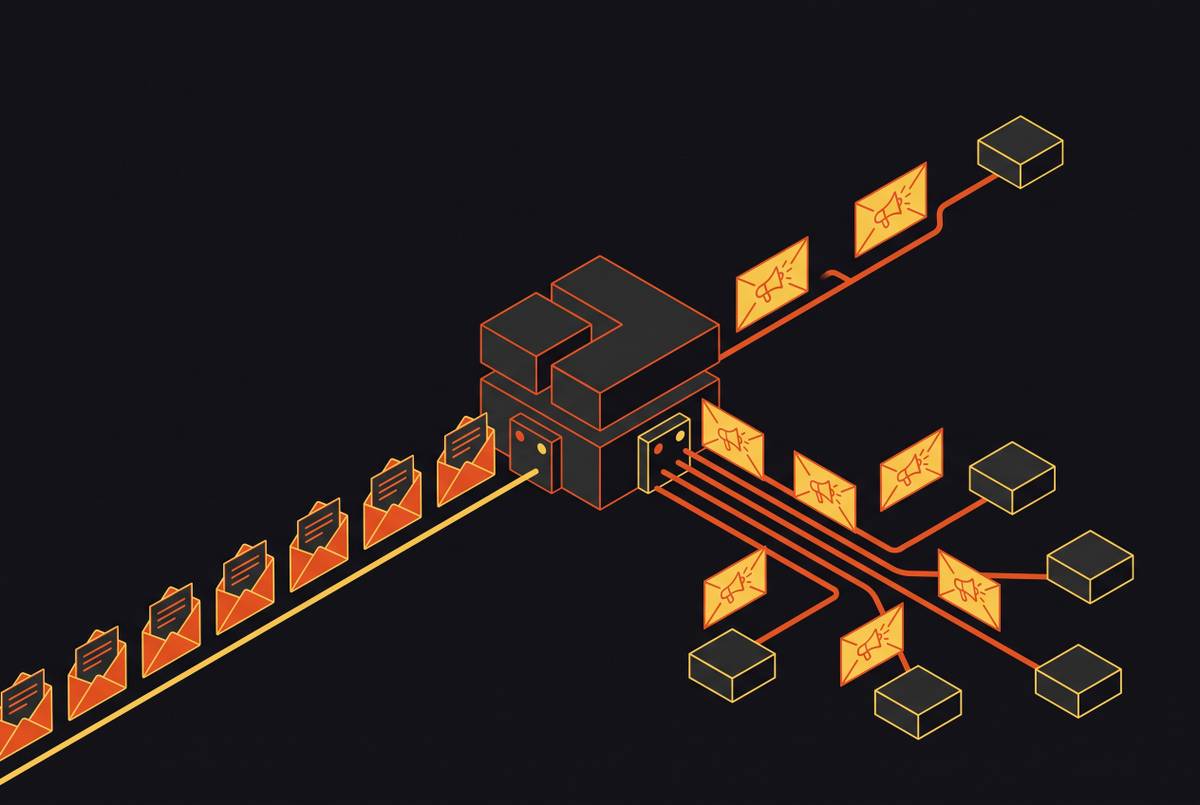
Email infrastructure purpose-built for AI agents lets an agent send, receive, and maintain conversations while enforcing limits, compliance, and failure controls outside the prompt. When an agent owns every step from trigger to thread, the decisive infrastructure choice is to treat it as the operator acting without a human who will review its work.
Why email infrastructure built for humans breaks when agents become the operators
A reply arrives, but the agent never resumes its workflow. Or a malformed message reaches recipients because the sending API accepts it without the review a human would have supplied. These are failures of the operating model. Conventional email infrastructure assumes someone reads errors, corrects drafts, and decides whether another send is appropriate. An autonomous agent removes that person without removing the need for those decisions.
The mismatch appears in four connected gaps, namely programmatic inbox provisioning, inbound event handling, thread state tracking, and pre-send safety controls. Without inbox ownership, the agent cannot reliably receive replies. Without inbound events and durable thread state, it cannot pick up an asynchronous conversation where it left off. Without safety controls, nothing intercepts a bad send before delivery. The Agentverse paper treats agents as first-class participants in digital infrastructure rather than add-ons to systems built for people, and email shows what that means in practice.
The six infrastructure layers an agent must own, and what breaks if any one is missing
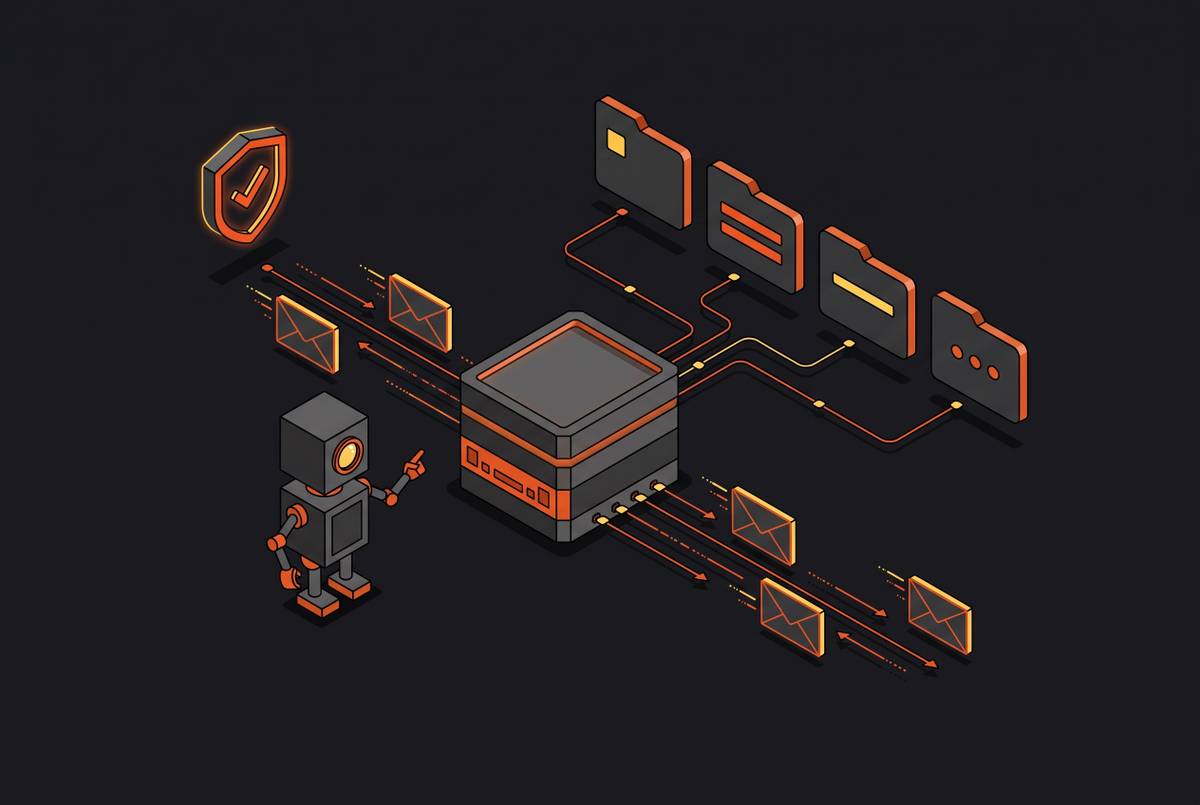
Agent email infrastructure spans six layers, which are domain identity, sending configuration, inbound handling, thread state, compliance defaults, and failure controls. They form an interlocking system. Domain identity establishes an authenticated sender separate from the primary company domain, while sending configuration constrains how quickly and frequently that identity can send. Neither can compensate for an inbound layer that never tells the agent a reply has arrived.
Inbound handling supplies that event through a webhook or SSE channel, and thread state connects it to the right conversation across restarts. Visual threading in an email client cannot give an agent durable state it can read. Compliance defaults apply unsubscribe controls, suppression checks, and lawful-basis metadata without relying on the agent to request them. Failure controls then use machine-readable responses to enforce rate caps, recipient allowlists, and pre-send checks. A gap in any layer leaves the others operating with incomplete information or authority.
Domain identity decisions and why the sending domain comes first
A sending domain links the agent’s output to a reputation that affects delivery. If that identity is the primary company domain, an agent’s mistakes can also affect invoices and security alerts. Domain isolation therefore belongs before the first send.
The appropriate foundation is a secondary domain clearly associated with the brand, with its website redirected to the main site. SPF, DKIM, and DMARC with alignment are prerequisites. Senders of large volumes to personal Gmail accounts must meet that baseline or face systematic filtering. Authentication establishes the sending identity, while separation limits the reach of reputation damage.
Provisioning must also fit the operating model. An agent managing multi-tenant deployments needs programmatic domain provisioning at runtime rather than a dependency on someone completing DNS setup through a control panel. Later controls can restrict sending behavior, but they cannot retroactively isolate damage already done to a shared domain.
Sending configuration decisions that change when an agent controls rate and timing
An agent can operate continuously without fatigue or judgment about when to pause. Its sending configuration must set those limits through per-mailbox daily caps, burst limits, and quiet-hour rules. Prompt instructions cannot serve as quota enforcement. A rate-limiting model calibrated to human activity can let an agent exhaust an account quota quickly, producing configuration errors that resemble service outages.
Per-agent and per-domain limits provide the necessary isolation. A runaway agent should exhaust its own allowance without interrupting other agents or the main sending domain. Warm-up constraints also make mailbox rotation a setup decision, with volume spread across several mailboxes. The agent cannot safely improvise that arrangement.
If bulk send is absent from the MCP schema, the agent cannot invoke that operation through the interface, regardless of its instructions. Tool design therefore governs more than argument formatting. It defines which sending actions are available before the agent begins choosing among them.
MCP as the integration layer for agent email infrastructure
MCP is an open, standardized protocol through which a language model invokes external tools using a structured client-server interface. An MCP server wraps the email API and exposes actions the agent can call without custom integration code for each provider. The protocol choice is therefore an infrastructure decision. It connects the allowed operations to the agent’s runtime so that every call path no longer has to sit in application code.
That distinction affects how a platform exposes its capabilities. An MCP catalog added to a human-facing REST API can retain the shape of a dashboard, whereas an agent-oriented catalog follows the tasks the agent must discover and sequence. Runtime tool discovery becomes useful when the workflow is not fully specified at build time. The agent can inspect the available operations before selecting one.
MCP offers its clearest advantages through multi-provider portability, runtime discovery, and structured audit logs. Those benefits support governance and observability as deployments grow. For a single-provider prototype, however, a direct REST call is simpler, and the protocol’s overhead is not justified merely because the caller is an agent.
Inbound handling and thread state beyond outbound-only APIs
An outbound-only API stops being sufficient when a workflow needs a reply before it can continue. Polling a shared human inbox substitutes a fragile dependency for an inbound architecture. Forwarding rules drift, and OAuth tokens expire. Webhook or SSE delivery instead resumes the agent’s loop when a message arrives, avoiding polling latency and wasted compute.
The reply must then reach the correct conversation. Programmatic matching on In-Reply-To and Message-ID headers provides a basis that subject-line matching does not, while durable thread state preserves that association across restarts, retries, and unexpected replies. Multi-tenant deployments also need isolated inboxes per agent or customer. Agent A’s reply must not start Agent B’s workflow.
Inbound processing must account for duplicate delivery as well. When delivery acknowledgment fails, retries can deliver the same message again, and starting a fresh loop for each copy duplicates actions and corrupts thread state. The correct pattern stores each processed Message-ID durably and checks it before initiating the agent loop. Multiple deliveries then produce a single action.
Idempotency and retry behavior in outbound transactional sends
The symmetric failure occurs when an agent wakes on schedule after a restart, finds no record of its earlier work, and sends the same message again. The recipient gets the message twice even though each tool call looks valid on its own. Testing can easily miss this failure mode.
Outbound idempotency therefore needs a key derived from the business event, such as invoice_1234_receipt, independent of a request timestamp or generated UUID. That stable identity collapses a retried tool call, repeated agent step, or webhook redelivery into one send. A new request identifier would instead distinguish attempts that represent the same obligation.
Password resets, security alerts, and receipts should use templates that have been reviewed and have required variables. A missing required value can cause a clear error, while a password reset delivered with literal {{reset_link}} cannot be used and produces no immediate delivery error. Idempotency and templates establish the first defenses, but neither checks every condition that can make a send unsafe.
Pre-send linting and guardrails at the tool boundary
The remaining checks belong at the MCP server or API endpoint that accepts the send request. This is the last interception point before delivery. Instructions in a prompt cannot provide equivalent enforcement because the agent may disregard them, and their failure produces no structured error.
A production linting layer checks for unrendered variables, missing unsubscribe links on marketing messages, missing or mismatched Reply-To addresses, and suppressed recipients. Address validation adds checks for syntax, MX record, and mailbox-existence when agents build lists of recipients without human review. These checks impose a small latency cost. By contrast, a batch of hard bounces can damage domain deliverability for weeks, and an unchecked message can reach thousands of inboxes before intervention.
Rejection must return a structured error code and a specific fix the agent can act on. Risk tiering then preserves throughput without treating every message identically. Known-template receipts and confirmations can proceed after linting, while high-risk or first-time-pattern sends enter an approval queue.
Compliance defaults and why opt-in configuration fails
An agent cannot check a suppression system it has no tool to query, and campaign correctness cannot depend on remembering an unsubscribe header on every send. Compliance must run before delivery by default. RFC 8058 one-click unsubscribe should be added to every marketing message by default, and suppression validation should return a clear error code when it rejects recipients on global suppression lists, domain suppression lists, or complaint lists.
An agent might compose a newsletter but submit it through a transactional endpoint, bypassing subscription checks, CAN-SPAM footers, and List-Unsubscribe headers. Controls that depend only on the agent choosing the correct endpoint leave the underlying obligation unenforced.
Transactional messages also need a GDPR lawful basis that is written down, such as contract performance or legitimate interest, independently of consent. An X-GDPR-Lawful-Basis header makes that basis machine-readable and auditable. Storage requires equivalent architectural attention because indefinite thread retention conflicts with Article 5(1)(e) storage limitation requirements. Expiry policies must be defined when the thread store is designed, and deletion requests must propagate to every storage layer the agent has written to.
Failure handling and stop-rules before reputation damage compounds
Bounce rates and spam complaint rates must trigger automatic pauses because an agent will otherwise continue sending while the signals deteriorate. A mailbox paused early can recover. Sending more while complaints are high risks permanent damage to reputation that cannot be fully undone.
A pause also needs a controlled recovery path. Resuming immediately at full volume defeats the protection, so the stop-rule must include a re-warm requirement using the constraints applied to a new domain. Opt-out intent needs to be handled on its own because thresholds for the whole cannot catch each person’s request. An agent that confuses “please remove me from your list” with “I'd like to hear more” can keep contacting opted-out recipients before a stop-rule fires.
Structured delivery webhooks with trace ID propagation make these controls actionable by connecting outbound sends to their outcomes. Without that connection, neither the agent nor the infrastructure around it has the signal it needs to step in. A human operator can inspect a dashboard and pause a campaign. An agent running for six hours while a deliverability problem compounds has no equivalent intervention unless the infrastructure supplies it automatically.
What email infrastructure should a team choose for an autonomous agent?
The team should first check that all six layers are covered, rather than look only at price per send or deliverability rate. Programmatic domain and inbox provisioning establish ownership, while isolated per-agent limits constrain behavior. Inbound webhooks need HMAC signing and idempotency support, and thread state must remain usable across restarts. A first-class MCP server, enforced compliance controls, and machine-readable linting errors complete the operating requirements.
AgentiSend is built specifically for this use case, with a single API covering transactional and marketing sends, an MCP server and CLI designed as first-class agent tools, and a pre-send linting layer. Its linting intercepts malformed or non-compliant sends and returns structured errors before delivery. Separate products force the agent to manage two configurations, two authentication contexts, and two suppression states when it cannot ask a human which path to use.
General-purpose APIs offer familiar documentation, but familiarity does not supply runtime permissions, reply handling, or enforced defaults. Getting those decisions right makes handing an agent the keys to a sending domain a controlled operational choice.