Per-Agent Email Isolation Approaches Compared
Domains, subaddresses, scoped keys, and inboxes each isolate different risks.
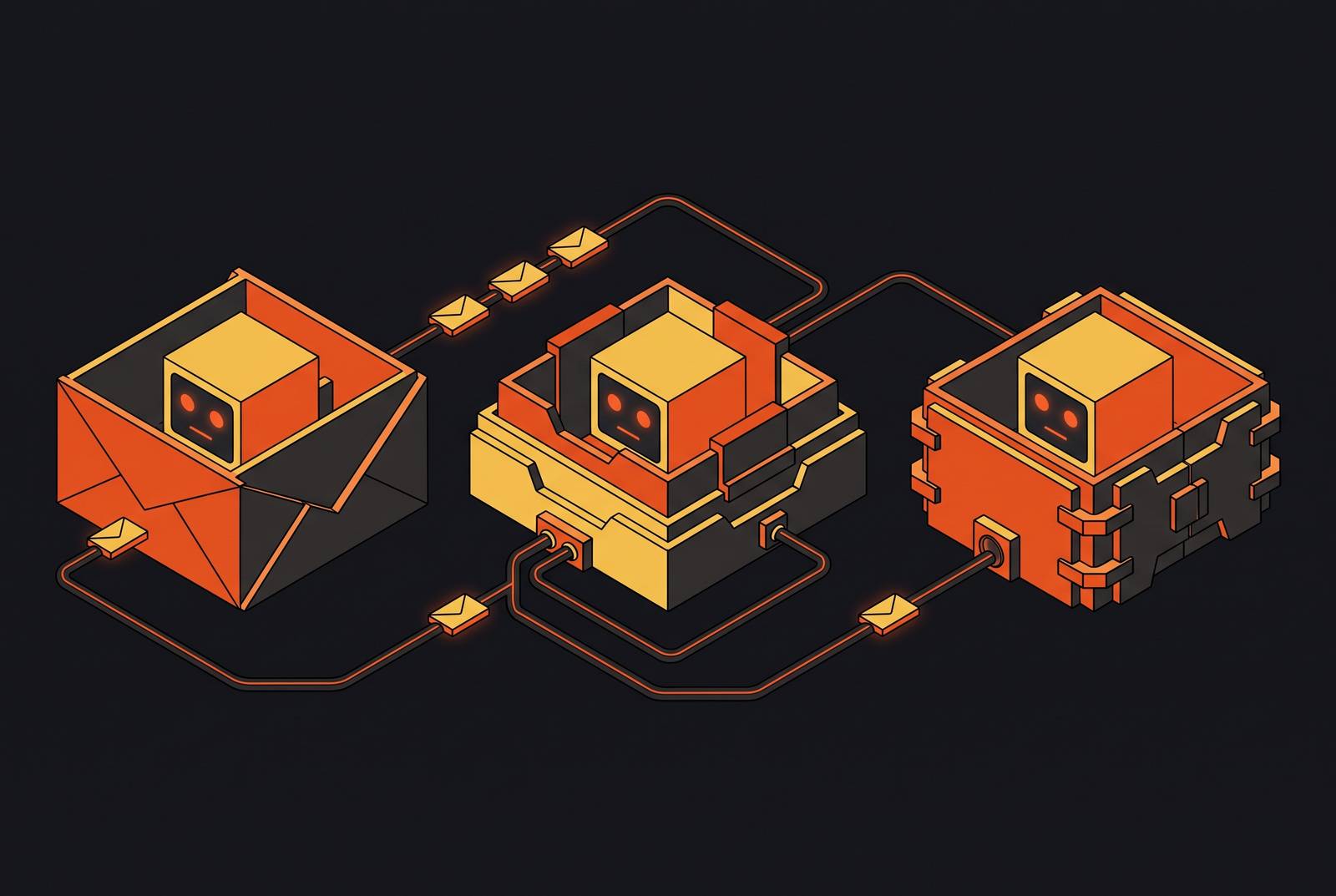
GIC - Agent Send has one transactional and marketing email API for AI applications, so agents can send receipts and newsletters without switching platforms. Dedicated domains, subaddress routing, scoped API keys, and provisioned inboxes control different boundaries, and the right combination depends on reply ownership, deliverability risk, and operational cost.
Why shared inboxes break under multi-agent concurrency
Two agents poll a shared mailbox simultaneously and ingest the same customer inquiry. Both start reasoning, call external tools, and send replies. This can lead to duplicate email and to actions outside the mailbox that conflict with each other. This race condition can happen even in a small deployment because agents share access to the mailbox but none has exclusive ownership.
Even if only one agent answers at first, ownership is again unclear when the customer replies. The shared inbox cannot deterministically return it to the agent instance holding the active execution state. Interleaved conversations compound that ambiguity, as a vendor may clarify contract terms while also raising a billing question. Agents then ingest overlapping histories, increasing token consumption and the risk of misattributing context. Adding distributed locks can restrict access, but a stalled reasoning pass or external tool call can block other work behind it.
The four capabilities that separate an agent-ready email layer from a transactional API
A sending credential gives an agent outbound access. The first requirement is programmatic inbox provisioning, so isolated tenant identities can be created at runtime without human intervention. The second is event-driven inbound handling through a webhook or event channel. Together, these capabilities establish where an agent's mail belongs and how its arrival becomes actionable.
The third requirement is thread state continuity through the In-Reply-To and References headers across turns. A conversation displayed neatly in a human email client does not itself give an agent programmatic continuity. The fourth requirement is per-agent safety controls, including rate limits, recipient allowlists, pre-send linting, and audit logging. An account-level daily cap constrains the account as a whole, leaving individual agent boundaries to per-agent controls.
These requirements provide the evaluation lens for each isolation pattern. GIC - Agent Send combines transactional and marketing email in one API with programmatic inbox provisioning, inbound event handling, header-based thread continuity, and per-agent guardrails. Its pre-send linting and compliance controls address the fourth requirement alongside the capabilities needed for the other three. The architectural question remains which boundaries a pattern supplies and which the surrounding platform must provide.
The isolation spectrum: four patterns and what each one actually controls
The four patterns divide responsibility at different layers. A dedicated sending domain assigns an agent or functional group its own subdomain, such as support-agent.yourcompany.com, with authentication and reputation scoped at that level. Subaddress routing instead adds recipient tags to an existing mailbox, as in ops+triage-agent-4f2@company.com, and dispatches messages according to those tags.
API-key-scoped identities give agents their own credentials and permissions even when they share a sending address. A provisioned per-agent inbox goes further by assigning a unique mailbox, inbound queue, webhook endpoint, threading context, and outbound identity. These are not mutually exclusive options because a domain boundary, a credential boundary, and an inbox boundary serve different purposes. A production architecture can therefore combine a dedicated subdomain, provisioned inboxes, and scoped keys to serve these different roles.
Dedicated sending domains: strong deliverability isolation, high DNS overhead
Dedicated sending domains constrain the blast radius of a damaged sender reputation. Separating support, billing, and marketing traffic means a high-volume agent does not place every stream under the same sending-domain reputation. This is the strongest reputation boundary among the four patterns, although reputation scoring also operates at the IP level. Domain separation protects at the domain level, so other deliverability controls are still needed.
Transactional replies can use one subdomain while marketing broadcasts use another. Transactional streams are exempt from the one-click List-Unsubscribe requirements that marketing streams must meet. A unified API can serve both streams without requiring them to share a sending identity.
That protection carries recurring DNS work. Each subdomain needs SPF and DKIM records, while DMARC is inherited from the parent unless a subdomain-specific policy is required. This is manageable for a small, stable set of agent classes such as support, billing, and onboarding. It becomes burdensome when hundreds of ephemeral or tenant-scoped identities each require new records. The alternative is a pod model in which a platform manages authentication for a shared agent subdomain and provisions individual identities beneath it without new DNS entries for every agent.
Subaddress routing: low setup cost, no actual isolation
Subaddress routing is inexpensive to establish because it creates labels that routing rules can dispatch to different handlers without new DNS records or mailbox provisioning. That makes plus-addressing useful for prototypes and low-risk internal workflows.
All tagged addresses still share a mailbox, sending-domain reputation, and authentication setup. Consequently, an agent sending from ops+agent-x@company.com can damage the same domain reputation used by sibling agents and the primary sending identity. Activity is also tied to the shared mailbox, which has no built-in per-agent audit trail.
Two handlers working on different tags can get in each other's way if access to the mailbox is not coordinated, and tag matching does not provide distributed locking. Subaddressing is therefore appropriate when volume and risk are low, deliverability separation is unnecessary, and a message broker manages concurrency above the mailbox layer.
API-key-scoped identities: operational isolation without inbox separation
A distinct API key gives each agent a revocable capability envelope. An agent can be allowed to send messages and create drafts without being allowed to manage the workspace or delete messages. If that credential is compromised, it can be revoked without disrupting sibling agents or human administrators. Short-lived keys that expire after task completion further reduce the exposure from a credential leak.
Separate keys also make outbound activity attributable. Each send can be traced to the key that dispatched it, together with its timing and parameters. That record supports incident investigation and compliance work without depending on a shared From address to identify the actor. Least privilege is strongest when tokens are bound both to specific operations and to the inboxes those operations may affect.
Agents with distinct credentials can still share a sending address whose replies land in the same queue, leaving ownership and thread continuity unresolved. Scoped keys therefore fit outbound-only notification senders, report dispatchers, and receipt generators particularly well. They also belong within provisioned-inbox architectures, where credential restrictions reinforce the mailbox boundary supplied by provisioning.
Provisioned per-agent inboxes: full isolation, highest operational surface
A provisioned per-agent inbox gives two-way agents the boundary the preceding patterns lack. Each agent owns its inbound queue, so replies can return deterministically to the instance holding the active thread state. An inbox platform can inject In-Reply-To and References headers on outbound replies and track continuity without making the agent reconstruct it from raw MIME. Logging both directions against that inbox also provides a coherent per-agent audit record. Combined with platform-managed guardrails, this pattern can close all four capability gaps.
A webhook or WebSocket fires when a message arrives and delivers the thread payload without mailbox polling. For multi-tenant products, inboxes can be grouped into pods with scoped keys and custom domains. This separates tenant management from individual agent provisioning. Each inbox has its own identity for address-level separation, but domain authentication and reputation still need to be managed.
The cost is a larger lifecycle surface. Creation, suspension, and deletion must be automated, or terminated agents leave orphaned inboxes behind. Per-inbox rate limits also need monitoring as the population grows. Send retries need deduplication keyed by message_id, and receiving a duplicate event should return 200 OK without starting another agent execution loop. Inbox ownership removes cross-agent mailbox races, but it does not make retries inherently idempotent.
An agent-ready API can absorb much of this work by layering subdomain provisioning, scoped credentials, and inbox lifecycle management behind one interface. That is the relevant architectural role for a unified platform, rather than simply shortening the call that creates an address. Developers still need a defined lifecycle and retry policy even when the platform manages the underlying email infrastructure.
How pre-send linting changes the risk calculus across all four patterns
Isolation controls identity and routing, but it does not validate what an agent sends. An isolated agent can still emit an unrendered {{first_name}} variable, omit a marketing unsubscribe link, or address a suppressed recipient. Each error can leave through a correctly authenticated, properly scoped inbox. A check before dispatch is still needed alongside the controls on identity.
Post-send monitoring cannot perform that role. By the time a complaint or bounce signal appears in Postmaster Tools, the message has already been sent. Unsupervised agents may dispatch thousands of messages between a bad send and its detection. A pre-send linting layer instead intercepts each message before it reaches the MTA and checks rendered variables, unsubscribe headers, suppression membership, and recipient consent. Structured errors with specific fixes let the agent respond before a recipient is affected.
The guardrail layer in GIC - Agent Send applies this approach to transactional and marketing streams through a single API. Every send goes through linting before it leaves, and machine-readable errors show what needs to be fixed. Marketing compliance requires one-click unsubscribe and a 48-hour unsubscribe window, and November 2025 enforcement puts delivery at risk when those rules are not met.
Pre-send validation also complements staged autonomy. The rollout begins with read-only access, advances to drafts and test sends, then moves through human approval to capped autonomous sends with alerts. Monitored autonomy adds daily and per-campaign caps. Those caps limit how much mail goes out, while linting checks for errors in each message. Neither control replaces the other.
Matching isolation pattern to deployment shape
The decision turns on three questions, namely whether replies are needed, how many identities must exist, and how much infrastructure the team is willing to own. For an outbound-only fleet with fewer than a dozen identities, dedicated subdomains per agent class and scoped keys provide a manageable combination. Provisioned inboxes add little if those agents never receive replies. Low-risk internal prototypes can use subaddress routing when a broker already manages concurrency and reputation separation is unnecessary.
Two-way agents change the answer because they require reply ownership. For dozens of stable identities, provisioned inboxes under a shared authenticated subdomain provide that ownership without per-agent DNS work. Idempotency keys remain mandatory. For hundreds of identities or ephemeral agent populations, platform-managed authentication, rate limits, and deprovisioning become central to the design. Giving each agent a dedicated domain takes too much DNS work at that scale, and subaddress routing lacks the boundaries these agents need.
For multi-tenant products, the pod is the appropriate tenant-level unit, with scoped keys per pod and a custom domain per tenant. The developer maps pod IDs to tenant IDs while the platform owns the deliverability surface. Teams seeking that division of responsibility can consider GIC - Agent Send for outbound-only and moderate-to-high-scale two-way deployments, with transactional and marketing streams served through one API. The sound architecture combines only the boundaries the deployment needs, but does not mistake one boundary for another.