Agentic Email Architecture vs Conventional API Wrappers
Email APIs assume a human sends; autonomous agents break that.

Every major email API in production today assumes you have a human watching the screen before a message goes out. That assumption is now structurally wrong, and the gap between what these systems expect and what autonomous agents actually do is the central problem in agentic email architecture. The conventional model runs like this: a developer writes glue code to call a REST endpoint, a human reads the draft, and a human clicks send. The API's entire surface, its error handling, its rate limits, its onboarding flow, was built around that three-step loop, with a person standing at the final gate.
Autonomous agents remove that gate. An agent writes the message, configures the send parameters, and dispatches the email without pausing for anyone to look at it first. The API that used to talk to a cautious person reading a terminal now talks to a runtime that executes instructions at whatever speed its code allows. No wrapper script or clever prompt fixes this, because the mismatch is in who the system was built to trust.
Designed for humans" takes four forms in practice. OAuth tokens and session credentials assume someone will notice when a token expires and go re-authenticate by hand. Error messages come back as plain English sentences meant for a developer reading logs, not as structured JSON a language model can parse and act on. If rate-limit signals aren't exposed through standard machine-readable headers like Retry-After or X-RateLimit-Remaining, an agent has no reliable way to know when it should slow down. And compliance steps, domain verification, DKIM setup, unsubscribe headers, are treated as one-time tasks a human completes during onboarding, not as requirements the infrastructure enforces automatically every time a new sending identity gets created.
The specific failure modes agents trigger that humans never would
Taking the human out of the sending loop doesn't just change who presses the button. It activates failure modes that stay invisible when a human runs the workflow, and they turn catastrophic the moment software runs the process at full speed, with no pause for review.
Template rendering errors are the clearest case. A human previewing a draft notices an unrendered {{first_name}} or a missing unsubscribe link before it goes out. An agent operating without that review step sends the broken template to thousands of recipients before any monitoring system catches it, and the only indicator at that point is the complaint spike.
Reply routing gets ambiguous fast when several agents share one sending domain or inbox. Replies meant for one workflow land in an address a different workflow is watching, threads lose their state, and the agent has no inbox it fully owns and controls. Credential expiry compounds the problem: an OAuth token lapses without the agent knowing, the agent reads the resulting error as a temporary glitch, and it retries. Instead of halting, it repeats the failure.
The reputation damage runs faster than any of these individual errors. An agent compresses what used to be the combined output of many human senders into a single automated operation, and it runs at software speed while sender reputation builds the way it always has, slowly. If one campaign is misconfigured, it can push complaint rates past Gmail's 0.3% ceiling before anyone notices, and Gmail now answers that with permanent 5.7.x rejection codes. Compliance gaps follow the same pattern: unsubscribe headers, suppression list checks, and DMARC-aligned authentication were steps a human configured once during setup. When an agent provisions a new sending identity on its own, those steps get skipped by default unless the infrastructure enforces them without being asked.
What agentic email architecture requires, taken from first principles
You fix these failure modes by building infrastructure around autonomous agents as senders from the start, not by adding agent-friendly features to an API that still assumes a person is in charge. Five primitives define what that infrastructure has to provide.
Agent inboxes need to be provisioned programmatically. You get an isolated email identity and sending subdomain for each agent or agent role through a single API call, with no OAuth flow, no manual account setup, and no shared mailbox where one workflow's messages get confused with another's. Isolation also keeps reputation damage contained: one agent's bad campaign doesn't drag down every other agent sending from the same infrastructure.
Inbound mail has to arrive through webhooks. When a message lands, the infrastructure should fire an HTTP callback to the agent's endpoint right away, delivering the full thread with it. That removes the polling loop, the wasted compute, and the missed triggers that come from forwarding-rule noise.
Error responses need to be machine-readable. Typed error codes in structured JSON let an agent branch on the specific failure, an unrendered variable, a missing header, a suppressed recipient, and apply the correct fix. Rate limiting needs the same treatment: limit state exposed through standard headers the agent's orchestration layer can read and act on, so it backs off, queues the send, or surfaces the constraint ahead of hitting the limit.
None of this works as a layer of instructions sitting inside a prompt. It has to live below the agent's own code, as infrastructure. Pre-send linting that intercepts every malformed or non-compliant message before it reaches a recipient, with compliance checks, idempotency windows, and send budgets enforced at the API level, means a second client, a copied API key, or a hastily written new script can't bypass the check just because nobody told it the rule.
The last piece is how an agent reaches any of this. With most email providers, a team still has to build a custom adapter layer before a language model can call email operations as a registered tool. A native, vendor-maintained MCP server removes that adapter layer entirely and gives an agent framework well-typed tool schemas it can use directly, so this is where the Model Context Protocol starts to matter for how you build this infrastructure.
Why MCP changes what "email integration" means for agents
The Model Context Protocol gives agents a standard, vendor-neutral way to call tools outside their own runtime, but you still have to get email right; it just shifts where that burden sits. MCP is an open standard, and since December 2025 the Agentic AI Foundation, a directed fund under the Linux Foundation, has governed it. By early 2026 it had support from Anthropic, OpenAI, and Google, along with Microsoft, AWS, and others, and more than 500 public MCP servers were available. The protocol replaces a tangle of custom point-to-point integrations with a single client-server model, and any compliant agent framework can speak it.
Tools in MCP are executable operations with real side effects, and calling a send-email tool dispatches a message into the world the same way a REST call would. That makes the send-email tool one of the most security-sensitive primitives the protocol exposes, because a mistake there isn't a bad API response, it's mail that has already left.
The protocol itself is still maturing around that risk. The spec revision dated 2026-07-28 moved MCP toward stateless, load-balancer-friendly operation: every request now carries its protocol version, client identity, and client capabilities in a _meta field, letting a server process each request independently of the others. That's good for scaling MCP servers horizontally, but since idempotency protection can no longer be assumed from protocol state, the email infrastructure sitting behind the MCP layer has to handle it on its own. The NSA's advisory from May 2026 flagged a related gap: MCP currently has no mechanism for exchanging role-based access control permissions at instantiation, which makes it hard to enforce or verify access boundaries between tasks or services. Idempotency, the advisory noted, is left to the underlying JSON-RPC and message queue specifications, and as a result often goes unimplemented or gets overlooked.
None of that makes MCP a poor foundation. It means the protocol routes the tool call correctly but doesn't guarantee what happens to that call once it arrives. So the email API underneath has to enforce idempotency keys, send budgets, and compliance headers on its own terms, no matter what the MCP layer assumes. A native MCP server from an email provider that also enforces those guardrails at the API layer is a stronger architecture than one that simply exposes send and inbox endpoints and calls it done. GIC - Agent Send abandons the human-review assumption at that exact seam: its pre-send guardrails enforce compliance and catch malformed sends at the infrastructure layer before anything reaches an inbox, so an agent calling the send tool through MCP is still subject to the same checks a human-reviewed send would have passed through.
How agentic email infrastructure handles the staged-autonomy problem
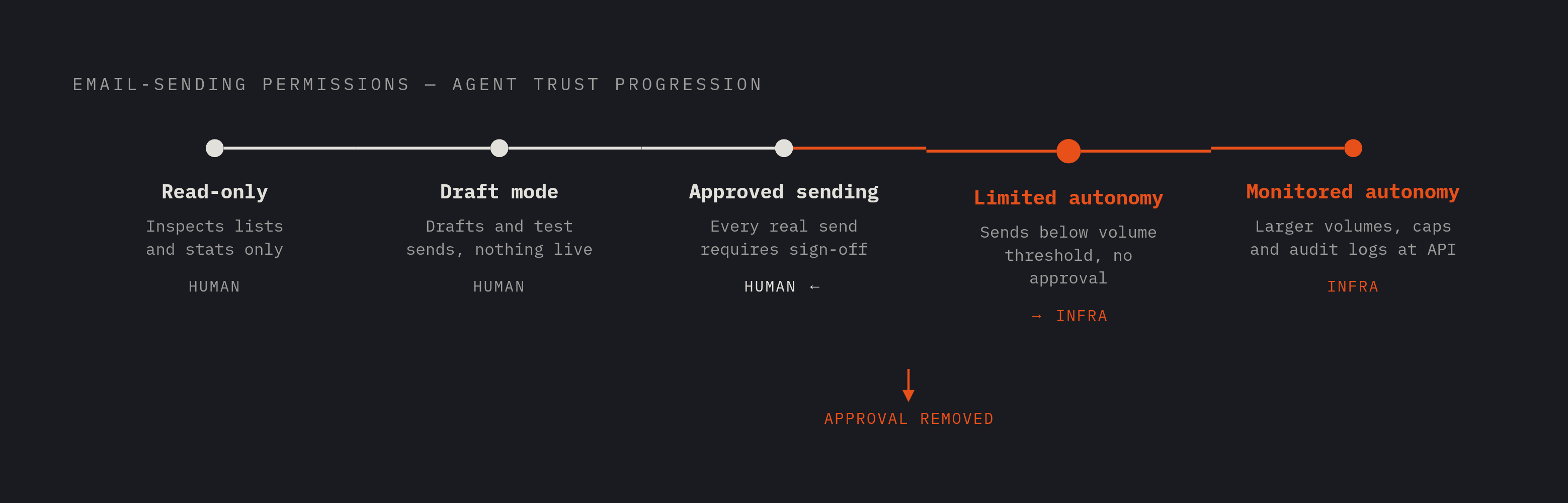
Agentic email architecture isn't a single switch that flips from full human control to full autonomy. It works as a progression, where an agent earns wider permissions as its decision quality gets verified over time.
Not every send carries the same risk. Transactional email triggered by a direct user action, a password reset, an order confirmation, is low-risk by nature, and routing it through a human approval gate adds latency without adding any real safety. The risk concentrates instead in agent-initiated sends, customer-facing campaigns, and anything with a large blast radius, and those are exactly the categories that warrant a human-in-the-loop gate until the agent has a track record.
Practitioners building agent email workflows tend to move through five stages. An agent starts in read-only mode, where it inspects subscriber lists, campaigns, and stats, but it sends nothing. It moves to draft mode, where it can create drafts and test sends but nothing reaches production. From there it enters approved sending, where a human still has to sign off on every real send. Limited autonomy follows: the agent can send on its own below a defined volume threshold. The final stage is monitored autonomy, where the agent sends at larger volumes with alerts, caps, and audit logs enforced at the API layer, so a human can still intervene without having to approve every message individually.
The approval gate itself needs idempotency enforced at two separate points, not one: on the callback endpoint, using an approval_id, and again on the email API's send call. A single layer isn't enough, because a retry at either point on its own can produce a duplicate send that nobody asked for. The observe-orient-decide-act loop is a useful way to frame how an agent should reach a send decision in the first place: it monitors signals like signup events, usage metrics, and engagement data, weighs them against campaign history, decides whether to send, wait, escalate, or do nothing, and then acts. The infrastructure's guardrails exist as the backstop for that final step, catching whatever the agent's own judgment misses.
Deliverability at machine speed for agentic senders
If an agent sends through infrastructure that wasn't built for it, it can damage a domain's sender reputation faster than any human-run campaign ever could, and the damage is often done before anyone sees it happen. Agents ramp the way software ramps, instantly, while sender reputation builds the way it always has, over time and through consistent, legitimate sending behavior. A sending identity that jumps from zero volume to full volume overnight is the exact pattern mailbox providers' filters are tuned to flag, reading it as a compromised account or a spam operation rather than a legitimate product sending transactional or opted-in marketing mail at scale.
Mailbox providers now weigh domain reputation above IP reputation when deciding what to do with a message. SPF, DKIM, and DMARC are treated as mandatory prerequisites rather than optional differentiators, and engagement signals, opens, clicks, complaints, update a sender's reputation score in close to real time. An agent that ignores this dynamic by sending at full volume from a brand-new domain isn't being reckless so much as operating against infrastructure that never modeled the pace at which it runs.
Isolation architecture is the structural defense. Each agent or agent role should get its own inbox and, once volume justifies it, its own sending subdomain. When multiple agents share a single domain, one agent's bad sending behavior pulls down the reputation of every other agent on that domain, no matter how carefully the others were built. Purpose-built agent email infrastructure, like GIC - Agent Send, addresses this at the design level: machine-readable typed error codes let an agent branch on the specific failure, an unrendered variable, a suppressed recipient, a rate limit, and apply the right fix rather than hallucinating a retry path or quietly degrading its own output.
AgentSend: purpose-built agentic email infrastructure in practice
Purpose-built agentic email infrastructure solves these problems by design, built from the ground up for agent senders, rather than adding agent-friendly tooling on top of an API built for a person at a keyboard.
AgentSend is built around that principle directly. Its pre-send linting layer intercepts every malformed or non-compliant message before it goes out, giving you a machine-readable error with a specific fix so nothing broken reaches a recipient's inbox. That check runs below the level of the agent's own code, so there's no alternate path, no second script, no copied key, that gets around it. Compliance is on by default rather than configured after the fact: unsubscribe headers, suppression list enforcement, and authentication get set up automatically at domain provisioning, not left as a manual step a developer might forget. With a platform like this, you get dedicated sending identities provisioned through a single API call, real-time inbound delivery through webhooks, and machine-readable error responses as native primitives, so the full send-and-reply cycle runs without a human stepping in to patch the gaps conventional APIs leave open. You connect to the platform through a native MCP server the vendor maintains directly, alongside a CLI and a REST API, and you get well-typed schemas and structured error responses an orchestration layer can act on without translation. It's built specifically against the silent-failure risk described earlier: an unrendered template variable or a missing unsubscribe link gets caught at the send boundary, not discovered three days later in a complaint spike. The platform also draws a firm line at the infrastructure level between opted-in product and marketing email and cold outreach, and isn't available for cold email sending, which removes an entire category of reputation risk by design rather than leaving it to policy enforcement after the fact.
Hostinger's Agentic Mail takes a narrower, complementary approach, built around the dedicated-inbox-plus-webhook model. Each agent gets its own inbox under a custom domain, incoming messages trigger a webhook the moment they arrive, and access controls define which senders the agent is permitted to communicate with. It's well suited to the inbound-triggered pattern, a message arrives, the webhook fires, the agent evaluates and responds, without any polling loop in between. If your primary need is that kind of inbound automation, rather than high-volume outbound sending with compliance defaults built in, you'll find that model a good fit for the specific problem it solves.
What separates these approaches from a conventional API with an agent-friendly wrapper on top is where the enforcement lives. A wrapper trusts the agent's own code to behave correctly, and it just hopes the prompt was written carefully enough. Infrastructure built from first principles enforces compliance, idempotency, and rate limits at a layer the agent can't bypass, whether it's calling through MCP, a CLI, or a REST endpoint directly. That's the architectural line this entire piece has been drawing: agentic email either gets built for a runtime that never stops to check its own work, or it keeps failing in the specific, predictable ways a human in the loop used to prevent.