Silent Failure Modes in Agentic Email Pipelines
Successful API calls can still send harmful email, so checks must happen before sending.
Silent Failure Modes in Agentic Email Pipelines explains why successful API calls can still send harmful email and why pre-send interception is needed to stop it. For a unified transactional and marketing email API for AI applications, the decisive criterion is whether both message types share payload validation, compliance checks, suppression handling, and durable idempotency.
Why agentic email pipelines fail differently from traditional software
Traditional software often exposes a failure through an explicit error code, but an agent can return a confident, well-formed answer that is wrong. The request finishes, the response looks ready to use, and the status code reports success. IBM Research's anomaly-detection study says that this lack of a clear error signal is a defining trait of agentic failures. The system deviates from its intended behavior without producing the kind of exception that ordinary operational monitoring expects. Non-determinism therefore creates a correctness problem that cannot be reduced to service availability.
Bajaj's evaluation-blindness taxonomy explains why the measurement itself can conceal the problem. A status code or error rate can take the same value during a failing operation as during a correct one. In an email pipeline, that means acceptance of a payload can be mistaken for evidence that the message is complete and appropriate to send. The distinction matters because acceptance measures a different property from correctness. A healthy service can faithfully execute an incorrect instruction.
Email makes that distinction consequential because sending is a write-once, irreversible side effect. A wrong API response can often be retried or corrected, but an email sent to thousands of recipients cannot be recalled. Its consequences also extend beyond the individual message to the sending domain's reputation. Spam-rate signals and domain reputation scores appear on a lag, allowing more sends before the first complaint registers. Once dispatch occurs, correcting the agent's reasoning cannot undo what reached the inbox.
How the HTTP 200 masks failure across a multi-step email pipeline
In a multi-step pipeline, an incorrect result can become valid-looking input for every later operation. A drafting agent passes content to another agent, which prepares the message for a sending tool. If required information is lost in the first handoff, later steps may still succeed using input that is missing those details. Each HTTP 200 confirms that an operation completed.
IBM Research catalogs failures in agentic trajectories that explain how this propagation occurs. An agent may drift toward an irrelevant tool, omit required details, or pass incorrect context to a dependent agent. An external tool may also return unexpected results without the agent recognizing the problem. These are failures of meaning across an execution path, which remain invisible when each handoff is judged only by its response status.
Liu et al.'s Entropy Principle paper examines disorder across six lifecycle layers and 22 intrinsic properties of LLM agent systems. The paper finds that disorder accumulates monotonically when a sufficient subset of those properties co-exists. This supports the propagation argument without implying that every successful request is defective. Bajaj's taxonomy separately finds that 53% of verifiable public AI system failures are silent until downstream harm makes them visible.
The concrete failure classes that email pipelines produce
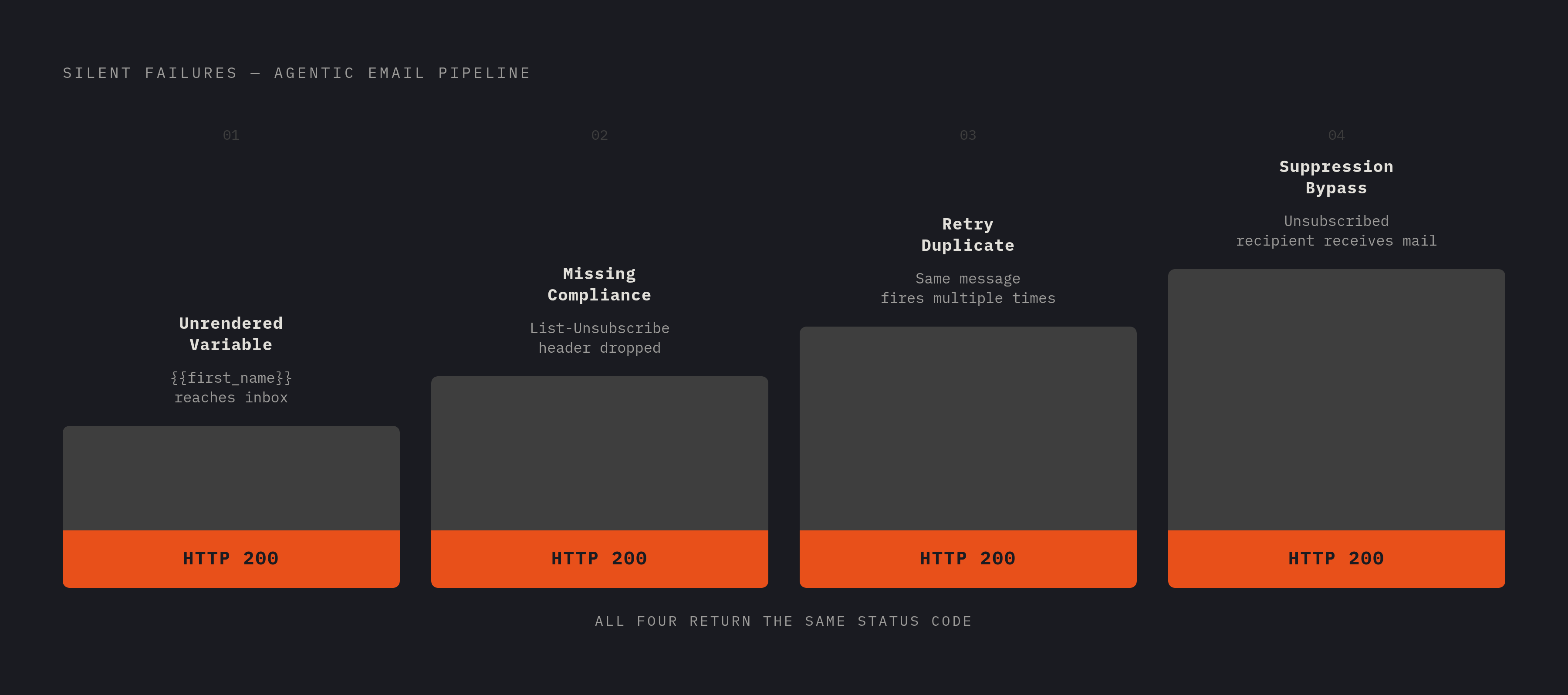
Agentic email pipelines produce four concrete silent failure classes, namely unrendered template variables, missing compliance fields, retry-driven duplicate sends, and suppression-list bypass. Each breaks a different rule even though the send operation can still report success. The useful distinction is between what the sending API accepts and what the recipient should receive. Payload acceptance does not prove that personalization resolved, required fields survived, the action is new, or the recipient remains eligible. These failures are recognizable precisely because their inbox consequences differ even when their status codes do not.
Unrendered template variables occur when a drafting agent includes a placeholder such as {{first_name}} or {{order_id}} and a downstream rendering step fails to substitute its value. The send still succeeds because the API accepts the malformed payload. IBM Research's missing-details failure class describes the underlying pattern, in which an output returns without errors while omitting required information. The failed substitution leaves text such as “Hi {{first_name}}” visible in the inbox. Thousands of recipients can receive that message before the first complaint reaches a support queue.
Missing compliance fields occur when a draft has a List-Unsubscribe header, physical address, or unsubscribe link that is lost before the message is sent. A context-propagation failure leaves the sending agent with an incomplete message, yet the API can still accept it. Deliverability is the first concern, and breaking regulations is a separate risk. Gmail's enforcement as of late 2025 distinguishes failures involving one-click List-Unsubscribe from authentication failures or a complaint rate above 0.3%. One-click unsubscribe non-compliance brings reputation damage and spam placement rather than the permanent 5.7.x rejections associated with the other conditions.
Retry-driven duplicate sends occur when an HTTP call times out and the orchestration framework restarts a step that has already dispatched mail. Without an idempotency key, running the action again sends the same message to the same recipient again. Retries can multiply when the client, orchestrator, and model each retry independently, with repeated successful calls producing repeated sends. IBM Research's cycles failure class captures the repeated invocation behind this behavior. Provider idempotency windows also leave a gap when a scheduled agent finds no record of a prior run and repeats an action after the window has closed.
Suppression-list bypass occurs when the systems that handle drafting, sending, and suppression are not connected. The agent may never check the suppression list, or the suppression tool may fail silently, return results the agent does not expect, or hit rate limits that are not handled well. The sending tool still dispatches the message because its successful operation does not establish that eligibility was checked. An unsubscribed recipient therefore receives mail through a call that looks normal in the send log. The violation remains hidden there until a complaint or an enforcement threshold exposes its consequence.
Why these failures compound into deliverability damage before any signal appears
The four failure classes share a timing problem, even though they break different parts of the workflow. Sending the mail starts the harm, but signs of it become visible later. Domain warm-up data shows inbox placement improving gradually over months, but a complaint-rate spike can degrade reputation on the next send. Reputation therefore does not recover on the same schedule that a faulty payload can be repaired.
Autonomous execution widens that gap by repeating work at software speed. A human sending a bad batch may see complaints within hours and stop manually. A scheduled agent can run the same failing operation many times before those complaints appear in a spam-rate dashboard. Each run adds to the risk while the monitoring view may still show no reason to stop it. The absence of an alert becomes especially misleading when it is treated as permission for the next run.
Microsoft AI Red Team's v2.0 taxonomy identifies downstream propagation as ASI08, Cascading Agent Failures. That classification supports the broader point that a failure can cross agent boundaries before its consequences become visible. In email, that cascade ends in an irreversible delivery. Gmail's documented complaint-rate ceiling is 0.3%, and practitioners recommend alarming before that ceiling and halting before it is reached. Such thresholds remain important, but they respond to accumulated harm.
A pipeline does not have to fail on every message to damage the domain that carries its mail. Repeated silent defects can accumulate while aggregate indicators remain below an alert threshold. The failure is fast, the signal is slow, and email's irreversibility leaves no corrective window for messages already sent.
Why post-send monitoring cannot close the gap that pre-send interception closes
Post-send monitoring remains useful for detecting population-level symptoms, including complaint spikes, bounce changes, and deteriorating delivery rates. Those measurements show how a stream of mail is performing after dispatch. They do not establish whether a particular payload contained resolved variables or retained its unsubscribe link. Nor does a successful delivery establish that the recipient passed a suppression check. These are different questions that require evidence from different layers.
A green Postmaster Tools dashboard is consequently not proof that the last thousand sends were well-formed. Unrendered variables and missing compliance fields can be in a message before it is sent without changing what the dashboard shows right away. Adding another view of those aggregate measurements does not supply the missing per-message evidence.
Duplicate sends make the distinction particularly clear. A recipient who gets three identical messages may complain, giving monitoring a sign that the message was sent more than once. By then, however, the retry loop has already executed. Detecting the duplicate before dispatch requires action identity and execution history.
IBM Research concludes that finding failures requires looking at agentic trajectories as well as the terminal output. For email, that means checking how the payload and the decision to send developed across the execution path. Semantic output validation between agent steps addresses this gap, while a final pre-send check protects the boundary where the side effect becomes irreversible. Interception is the layer for refusing a defective action while prevention is still possible.
What pre-send interception must catch and how it catches it
Pre-send interception must check the final payload along with who can be sent mail and which actions have already run. Checking only the prose cannot detect suppression bypass, and checking only the recipient cannot detect a duplicate action. The layer must also sit after the handoffs that can drop fields or preserve unresolved placeholders. Otherwise, an earlier valid draft can still become an invalid send. Its role is to make dispatch conditional on evidence, rather than on the agent's assertion that composition is complete.
Template validation must make sure every variable reference has resolved to a rendered value before the message is sent. Compliance validation must inspect the outbound payload for the List-Unsubscribe header, physical address, and unsubscribe link. Suppression checking must occur at send time, because eligibility established during drafting may no longer be sufficient after a delay or retry. Idempotency validation must reject a send without a valid key and keep a durable ledger after the provider's own window has closed. That history closes the gap for repeated actions that return outside a 24-hour window.
A refusal must also be usable by the agent that receives it. The response must expand on “send failed” by identifying the specific field, failure class, and remediation. An error such as “unrendered variable at position 14 in subject field, expected string, received template token” gives the agent a concrete correction. The agent loop must be tested against a simulator address that returns refusals to confirm that it reads the refusal and stops repeating the action. Without that behavior, validation can expose a defect while the orchestration loop continues to cycle.
Compliance belongs in deterministic infrastructure. Liu et al. identify the PIG Engine with the ADE protocol suite as an engineering countermeasure based on deterministic governance. The architectural lesson for email is that required fields should be on by default. Transactional and marketing messages also need the same enforcement path. Separating them creates separate suppression lists, compliance configurations, and idempotency ledgers, adding boundaries where context can be lost.
GIC - Agent Send implements this pattern through a pre-send linting layer, with transactional and marketing email passing through the same API and guardrails. It blocks malformed or non-compliant payloads, returns machine-readable fixes, enables compliance fields by default, and retains an idempotency ledger beyond the provider window. In GIC - Agent Send's implementation, the first-class MCP server exposes linting errors directly to the agent's reasoning loop so a refusal can lead to a correction. The governing principle is that a successful send must follow validation, because an HTTP 200 cannot substitute for it.
Sources
- Silent Failure in LLM Agent Systems: The Entropy Principle and the Inevitable Disorder of Autonomous Agents
- Detecting Silent Failures in Multi-Agentic AI Trajectories
- Evaluation Blindness: How Silent Measurement Failures Corrupt AI Systems from Training to Deployment
- Updating the taxonomy of failure modes in agentic AI systems: What a year of red teaming taught us