Designing Agent Email Capability Around Machine Identity Not Human Mailboxes
Separate email identities for agents prevent shared-credential failures and improve deliverability.
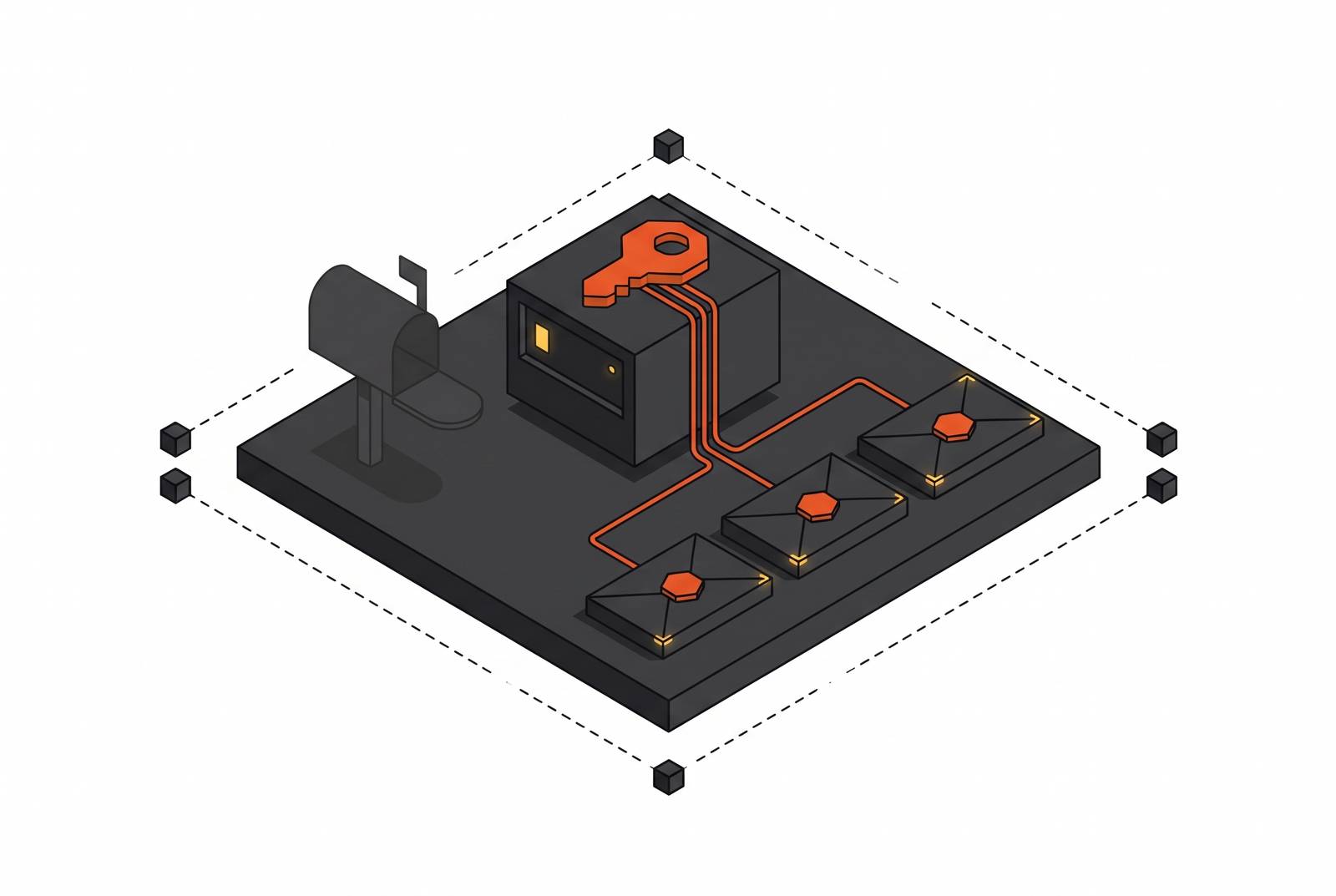
Email infrastructure built for AI agents starts with a machine identity in place of a human mailbox. An autonomous sender needs a dedicated sending domain, a per-agent From address, an isolated reputation scope, and credentials provisioned through an API. Designing around those artifacts makes deliverability, compliance, and governance enforceable by the infrastructure independently of the agent’s judgment.
Why human mailbox conventions break under agent sending conditions
An OAuth token expires, and the agent continues its work without knowing that its send path has broken. A forwarding rule filters a reply that should have triggered the next action. Several agents share one address, and a response reaches the mailbox without any agent knowing it owns the thread. These failures have the same structural cause. Human mailbox conventions assume that a person is present to inspect failures, renew access, and resolve ambiguity before the workflow continues.
That assumption extends beyond the inbox to the credentials behind it. Otsuka et al. (2026) report that most organizations run agents on shared API keys or inherited human credentials that were never meant for non-human use. Their analysis identifies a mismatch between OAuth and SAML, built for humans at browsers, and agents that spawn sub-agents without human oversight. Access alone does not establish accountable ownership. A credential can allow a send without making clear which agent sent it or which delegated process should handle the reply.
Scale makes that ambiguity harder to resolve through human supervision. Kurtz & Krawiecka (2026) report that non-human identities already outnumber human identities in enterprise environments by ratios exceeding 80 to 1. Shared inboxes and manually configured domains therefore become more than inconvenient setup choices. They leave autonomous workflows waiting for a person to step in just when those workflows need a clear, lasting owner. The resulting failures are symptoms of an identity model that does not fit the sender.
How do you give an AI agent its own email identity?
A dedicated sending domain separates an agent’s reputation from human senders and other agents. A per-agent From address gives recipients and inbox providers a stable sender whose behavior they can recognize. An isolated reputation scope keeps engagement signals attributable to that sender. Programmatically provisioned credentials let the infrastructure create and authorize the identity at runtime.
These artifacts serve different functions and are not interchangeable. A distinct From address identifies the agent, but a shared domain can still blend its reputation with other senders. Domain isolation contains that exposure, while the credential establishes which agent is authorized to use the address. Together, they connect permission to observable sending behavior. Without that connection, a shared address conflates signals, and a shared credential makes different agents appear to be the same actor.
Otsuka et al. define AI identity as “the continuous relationship between what an AI agent is declared to be and what it is observed to do”. In email, that relationship requires an address from which behavior is observable and attributable. Delegation adds another boundary to that relationship. Kurtz & Krawiecka treat agent-to-agent delegation as a distinct governance surface because inherited credentials can pass authority to other agents without keeping track of who is responsible. A dedicated machine identity anchors the action to a specific principal rather than merely to whoever possesses a human account’s credential.
Why the identity layer must be provisioned programmatically, not configured manually
Agents deploy at runtime, at scale, and without a human administrator necessarily present. Manual domain configuration and inbox setup introduce a synchronization problem into that deployment model. The agent may be ready before its identity exists, or credentials may exist before SPF, DKIM, and DMARC have propagated. Readiness is not the same as authorization. If sending begins in that gap, the receiving infrastructure cannot verify the identity under which the agent acts.
The architectural requirement is therefore stronger than an API that accepts messages. One dedicated mailbox per agent or agent role must be provisioned through an API, with the identity artifact and sending credential created atomically. Verified identity must be a condition of usable sending access. This keeps credential issuance within the same programmatic boundary as identity readiness. It also prevents manual setup from becoming the bottleneck each time an agent needs its own email capability.
AgentiSend’s API-first approach meets that need with a single API and MCP server for domain setup, sending, and compliance configuration. An agent can configure its sending identity without stepping outside the programmatic boundary. For practitioners selecting an email API, the distinction is whether the integration provisions the sender or merely transports its messages. Only the former puts identity in place before the downstream deliverability and governance controls depend on it.
How a weak identity layer becomes a deliverability problem before the first send
Sender reputation attaches to a specific identity formed by the domain, IP, and From address together. An agent using a shared identity therefore inherits a reputation it did not earn and cannot control. Domain reputation now outweighs IP reputation in how inbox providers evaluate a sender, while SPF, DKIM, and DMARC are prerequisites. Content quality cannot repair missing authentication or separate blended reputations. Deliverability is compromised by weak identity architecture before the agent chooses its first subject line.
Agents can ramp instantly, but a new domain’s reputation builds slowly. A domain with no warmup history sending at agent volume produces the same fingerprint as a compromised account or a spammer’s script, regardless of message quality. Software readiness does not establish sender trust.
Once sending begins, engagement continues to update reputation through replies, positive replies, messages marked important, and continued conversations. Those signals are per-sender, so a shared domain mixing human and agent traffic produces a blended record. Diagnosis then becomes difficult because neither sender’s contribution is clearly legible to the inbox provider. The structural remedy is a dedicated domain per agent or agent role, authentication configured at provisioning time, and warmup before activation at volume. For new domains, the prescribed warmup is four to six weeks minimum before the agent sends at volume.
The silent failure risk that shared credentials create for agentic email at scale
Deliverability concerns what inbox providers can infer about a sender. Governance concerns what the organization can establish about the same activity. An agent with direct SMTP credentials but no pacing layer and no attribution has no built-in brake and no audit trail it can rely on. A retry loop or a bad list can become hundreds of sends before anyone notices. The dangerous configuration is not merely a faulty template, but unrestricted sending access whose use cannot be traced to an agent run.
Shared credentials make that attribution failure systematic. The API log identifies only a key, leaving the agent responsible for a runaway send, compliance failure, or reputation incident unidentified. Otsuka et al. identify recursive delegation accountability as a critical unresolved gap. When agent A delegates to agent B, which calls the email API using the same credential, the log does not expose that chain. Kurtz & Krawiecka use the 2024 CrowdStrike outage as a case of ungoverned machine risk [1].
For agent email, the prescribed controls depend on knowing the sender. Infrastructure-enforced per-agent rate limits constrain activity even when the agent’s application code is faulty. Recipient domain policies cap sends to any single domain per hour, and escalation triggers pause the agent and alert a human when volume goes above a threshold. Audit entries need agent ID and agent execution ID with message ID, so the organization can trace the action to the run.
Why pre-send validation is the correct place to enforce identity and compliance rules
Post-send monitoring detects a problem after it has reached recipients. Pre-send validation can stop it before the message is sent. That distinction is consequential when a single agent run can send to thousands of addresses, turning a small unchecked error into a reputation incident. The rules must therefore be enforced between the agent’s send call and the actual dispatch. This is where infrastructure can evaluate the proposed action while it still has the ability to block it.
The linting layer needs three kinds of checks. Identity validation establishes whether the From address is authorized for the agent making the call. Compliance validation checks that requirements such as List-Unsubscribe are met and whether the recipient is on a suppression list. Content validation detects defects such as unrendered template variables. A failed check must return a structured, machine-readable error that says exactly how to fix it, because a human-readable bounce report cannot tell an autonomous sender how to fix the problem before delivery.
Separate tools with JSON schemas give the model a set structure to follow when making valid calls. The MCP server then enforces validation and governance rather than leaving those responsibilities to the agent’s application code. The model asks to take an action through that interface. The infrastructure decides whether the identified agent is permitted to perform it under the applicable sending rules.
Idempotency addresses a related failure that validation alone cannot prevent. An agent that wakes on a schedule, finds no record of a prior run, and retries can send the same message twice. The prescribed idempotency key is derived from stable inputs, namely the inbound message ID plus the action, hashed. Its window must exceed the agent’s retry interval, extending protection beyond a web-request timeout. Otherwise, a retry can outlive the protection intended to recognize it.
Compliance also needs to be active before sending begins. Unsubscribe headers, suppression lists, and List-Unsubscribe should be enabled by default. These checks do not replace identity controls. Per-agent enforcement works only when the infrastructure knows which agent is sending and which From address it may use. The dedicated identity established at provisioning is therefore what makes pre-send governance attributable and enforceable.
What an agent-ready sending identity looks like end to end
An agent-ready architecture assembles four dependent layers in sequence. Domain provisioning with authentication establishes the verifiable sender, per-agent credential issuance assigns authority, pre-send enforcement constrains its use, and audit attribution records what happened. None is a substitute for another. Authentication cannot identify a run behind a shared key, and a detailed log cannot prevent a send that should have been blocked. Each layer supplies a condition that the next one needs.
Implementation begins with a sending domain or subdomain dedicated to the agent role, separate from human sender infrastructure and other agent roles. SPF, DKIM, and DMARC belong in provisioning, before the first send. Warmup begins before agent activation and precedes sending at volume. Credentials are then issued through an API and scoped to a single agent or agent role. Each credential names its principal so that rate limits and send records are tied to the right sender.
The dispatch path then applies identity, compliance, and content checks to every proposed message. Failures return machine-readable errors with specific fixes, while idempotency uses stable inputs and a window sized to the agent’s retry interval. AgentiSend’s architecture combines a single API for transactional and marketing sends, an MCP server for agent-native tool calls, and a pre-send linting layer that returns structured errors. It is designed to supply the four layers through one integration point. The architectural fit comes from connecting provisioning to governed execution rather than requiring those functions to be assembled from separate products.
Every send log entry includes agent ID, agent execution ID, message ID, recipient, timestamp, MCP tool call parameters, the governance decision of allowed or blocked and why, and delivery status. That record connects the requested action to its authorization and outcome. Attribution is the least visible part of the design. Teams that omit it discover after an incident that they can identify the credential used, but not the agent run that caused it.