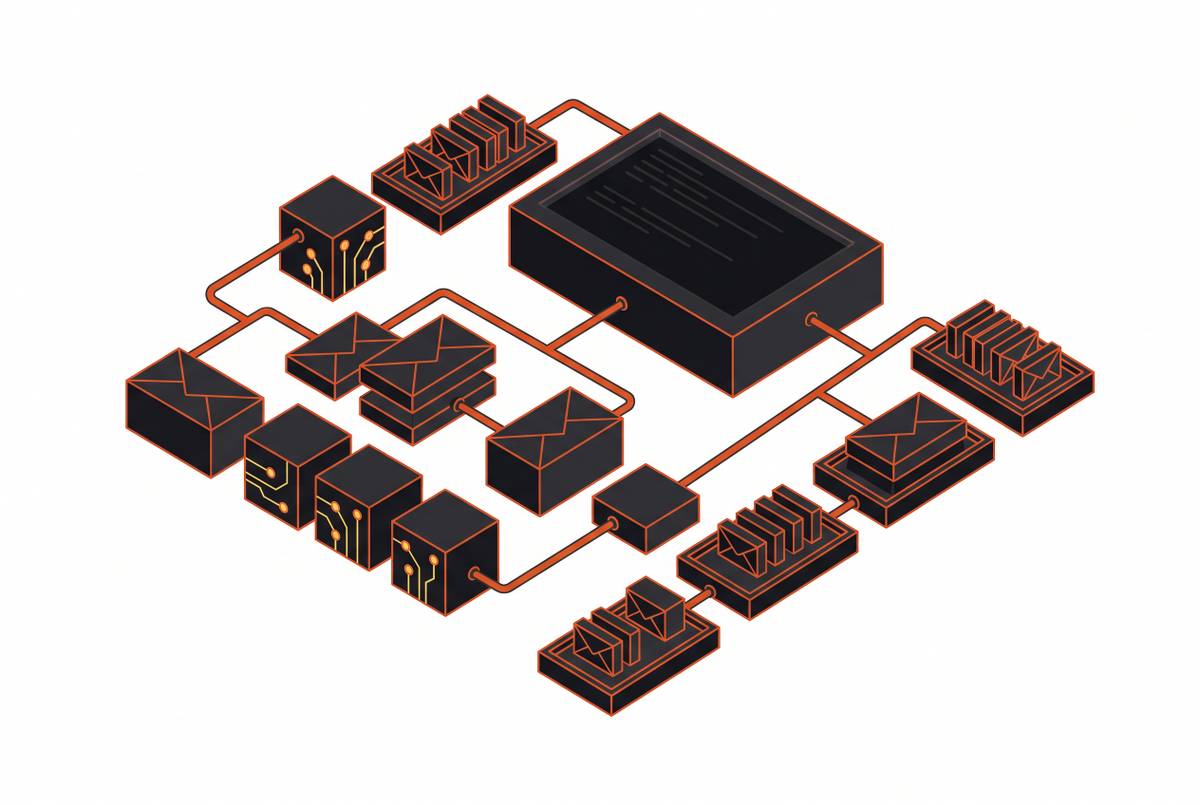
Why AI Agents Break When Transactional and Marketing Email Live on Separate APIs
Agents need unified email APIs to reconcile split suppression and send state.

AI agents need a unified transactional and marketing email API because separate APIs split up the state they need to send correctly. Shared suppression, send history, and permissions are correctness requirements when an agent sends both receipts and newsletters. AgentSend handles this split with pre-send guardrails that check the full send context and return machine-readable fixes before a message is sent.
How transactional and marketing email are architecturally different, and why that gap exists
Transactional email follows a request-response model in which a business event triggers a send. Marketing email follows a contact-based model in which a campaign targets a list with its own lifecycle, segmentation, and consent state. These are different units of work. One starts with an event requiring a message, while the other starts with an audience whose eligibility can change independently of any business event.
Because these models differ, most mature platforms separate their sending streams, suppression lists, compliance rules, and reputation pools, even under one account. Reputation isolation has a clear operational purpose. Marketing list churn must not impair the delivery of password resets, so the streams need distinct delivery boundaries. A human developer can operate across those boundaries by navigating separate authentication flows and manually reconciling differences between the two systems.
What changes when an agent is the sender, not a human developer
An autonomous agent cannot count on the context a developer draws on when working with two APIs. A person can read documentation, spot settings that disagree, and see when a change in one dashboard calls for an update elsewhere. The agent knows what its execution context exposes. If an API response omits state held by another service, that state is invisible unless the agent explicitly retrieves it.
This changes what counts as a complete operation. A successful call to one API does not establish that the send respects a preference recorded in the other, or that another stream has not already dispatched the message. Answering them requires the agent to query both systems and reconcile their records before treating the operation as correct.
An agent with a loop and a contact list can spread a misconfiguration across thousands of sends before a person sees the problem. The operational distinction is therefore not simply that an agent works faster than a developer. It is that the agent acts without the external context on which the split workflow previously depended.
Three coordination failures that split APIs produce for agents
The first failure is inconsistent suppression lists. Each API maintains its own record of recipients who must not receive mail, with no authoritative cross-system view. An agent using the transactional API cannot reliably establish whether the marketing system has recorded a relevant opt-out unless it queries both. The agent must therefore interpret potentially different suppression states at the point of sending, rather than depend on one record that already resolves them.
The difficulty includes the scope of the preference. Applying a marketing unsubscribe domain-wide can block critical transactional messages, while ignoring that preference can let commercial mail get past an opt-out through the transactional route. Neither “block everything” nor “trust this API” resolves the distinction. Correct handling depends on both the recipient’s preference and the message type, which separate lists do not reconcile by themselves.
The second failure is conflicting send-state and duplicate sends. Idempotency collapses retries and repeated executions of the same agent step into a single send, but it requires a shared, durable record of dispatch. Separate systems do not provide that shared record. A transactional retry cannot establish what the marketing service has already sent, so a re-triggered step can produce messages through both streams. Delivery retries are part of how infrastructure normally works, so this can happen in day-to-day use.
The Verkada case illustrates the consequences of systematic sending failures, though not proof of cross-API duplication. The CAN-SPAM enforcement action was over commercial emails sent over three years without any unsubscribe option. An agent operating across fragmented sending and suppression state could reproduce such a persistent omission without recognizing that the unsubscribe path was broken.
The third failure is split authentication contexts and permission scope ambiguity. Each API has its own credentials, access boundaries, and permission model, so authorization in one says nothing about authorization in the other. A correctly scoped transactional credential may coexist with an over-broad marketing credential. The agent receives no inherent signal of that mismatch. In particular, a draft-only boundary is not coherent across the workflow if the other API independently grants send authority.
Why pre-send linting cannot work across a split architecture
Pre-send validation needs all the state for the proposed send in one place. A linter can detect unrendered template variables or missing unsubscribe headers in a message, but suppression and duplicate-send checks require records beyond the message itself. Local validation is only a partial guardrail. A transactional linter cannot inspect marketing suppression without a cross-API query, while a marketing linter cannot natively see the same message being triggered through the transactional system.
That limitation also affects the error returned to the agent. A machine-readable error with a specific fix closes the feedback loop only when the agent can interpret and act on it within a coherent state model. “Recipient suppressed” needs an unambiguous scope. With separate lists, it may show that one stream blocks the recipient without saying whether that block applies to the other stream or to the proposed message type.
Custom coordination can supply the missing visibility, but then it becomes part of the infrastructure that must be maintained and synchronized. Linting now depends on a layer responsible for reconciling suppression, send history, and compliance state before validation can be trusted. Building that layer manually defeats the purpose of guardrails intended to remove this coordination work from the agent.
The compliance rules that make this a correctness problem, not just an inconvenience
Regulators and mailbox providers assess the resulting message. A split API does not excuse an invalid send. CAN-SPAM imposes liability per message sent in violation, while CASL treats each non-compliant message as a separate violation. GDPR bases fines on global annual turnover. These external consequences cannot be undone by discovering the mismatch in a post-send audit.
Message classification creates a separate compliance trap. Marketing sends require unsubscribe handling, including List-Unsubscribe headers, while the type-aware model must keep marketing opt-out behavior from suppressing critical transactional alerts. The same default cannot serve both purposes. An agent drawing from a merged template system without type-aware enforcement can omit the marketing controls or apply them to messages that should not inherit them.
The distinction makes correctness more demanding than successful API execution. A service can accept a message even when the broader workflow has interpreted consent or message type incorrectly. Transport success is not compliance success. Even better agent logic cannot sort out records it cannot see, and fixing a mistake later does not undo the original send.
What a unified email API actually means for an AI application
A unified API uses one authentication context for transactional and marketing sends, which share suppression and a common send-state store. An AI application sending receipts and newsletters can then work in one system without switching platforms. One account name is not enough. Both message types must share the state and the boundaries that enforce the rules, beyond having the same interface.
Shared suppression records resolve a recipient’s preferences with the message type before dispatch. A marketing unsubscribe excludes the recipient from sends that should respect that preference without indiscriminately blocking transactional mail. Classification governs how that preference is applied. The API can also apply unsubscribe defaults by type, so the agent does not have to reconstruct the compliance rules on every call.
With common send-state, business-event idempotency keys work across both streams. A retry checks the same durable record regardless of which message type the agent selected, preventing the same operation from becoming two sends. Unified permissions provide a corresponding authority boundary. Draft and send permissions work the same way in both streams, so the agent has no need to work out how unrelated credential models fit together.
Full-state linting then checks the suppression, message type, required headers, and template variables for the send together. Its errors refer to one operational context. This unification does not require combining the streams’ reputations, because separate sending subdomains can still isolate transactional and marketing traffic at the infrastructure level. State coordination and reputation isolation solve different problems, so preserving the latter does not require separate APIs.
How AgentSend's design addresses these coordination failures
AgentSend treats agents as first-class email senders. Its design starts from the coordination requirements that follow from autonomous execution. The practical expression is its guardrails layer. Pre-send linting intercepts malformed or non-compliant sends before dispatch and returns a machine-readable error with a specific fix, giving the agent a response it can act on without human interpretation.
The guardrails check the suppression state, message type, template variables, and compliance headers in the full send context. That scope distinguishes the mechanism from a check limited to message formatting or one stream’s local records. The feedback loop is part of the design. Instead of receiving a partial verdict that requires another platform lookup, the agent receives an actionable error grounded in the context used to validate the send.
The relevant property is where validation happens and which state it can inspect. A guardrail must precede the irreversible operation. For an autonomous sender, a rejection that says what to fix before dispatch helps more than a successful response that leaves application code to sort out suppression or compliance.
What to verify before handing an agent the keys to a sending domain
Before letting an agent send on its own, a developer should be able to answer yes to the checks below. These checks apply to any email infrastructure. The first is whether one query returns the complete suppression state for a recipient across message types, with enough context to distinguish a marketing opt-out from a restriction affecting other mail. If the agent has to read separate lists and work out what their differences mean, the application still has to handle suppression.
The next checks concern retries and authority. The developer should establish whether the API accepts a business-event idempotency key that collapses retries across transactional and marketing sends. The permission check is equally specific. A native draft-versus-send boundary should work the same way for both message types, so application code has no need to make up for another API granting more authority.
The developer should be able to check that machine-readable errors say what to fix before a message is sent, and that the validator sees the message type, suppression state, and required headers together. Compliance defaults need their own check. List-Unsubscribe handling, suppression enforcement, and bounce handling should be applied automatically by message type on every call.
Finally, the developer should check whether separate sending subdomains keep reputation isolation in place without the need for separate API accounts and suppression systems. Delivery separation should not reintroduce fragmented control state. Infrastructure that cannot answer yes to these checks requires the developer to build the coordination layer the API should have provided. GIC - Agent Send, an email infrastructure platform combining transactional and marketing email in a single API built for autonomous agents rather than adapted from human-operated tooling, is one option designed to answer yes across all of them.