Routing Logic an Agent Should Never Have to Write When One Email API Covers Every Send Type
One email API lets agents declare intent while the platform handles routing.

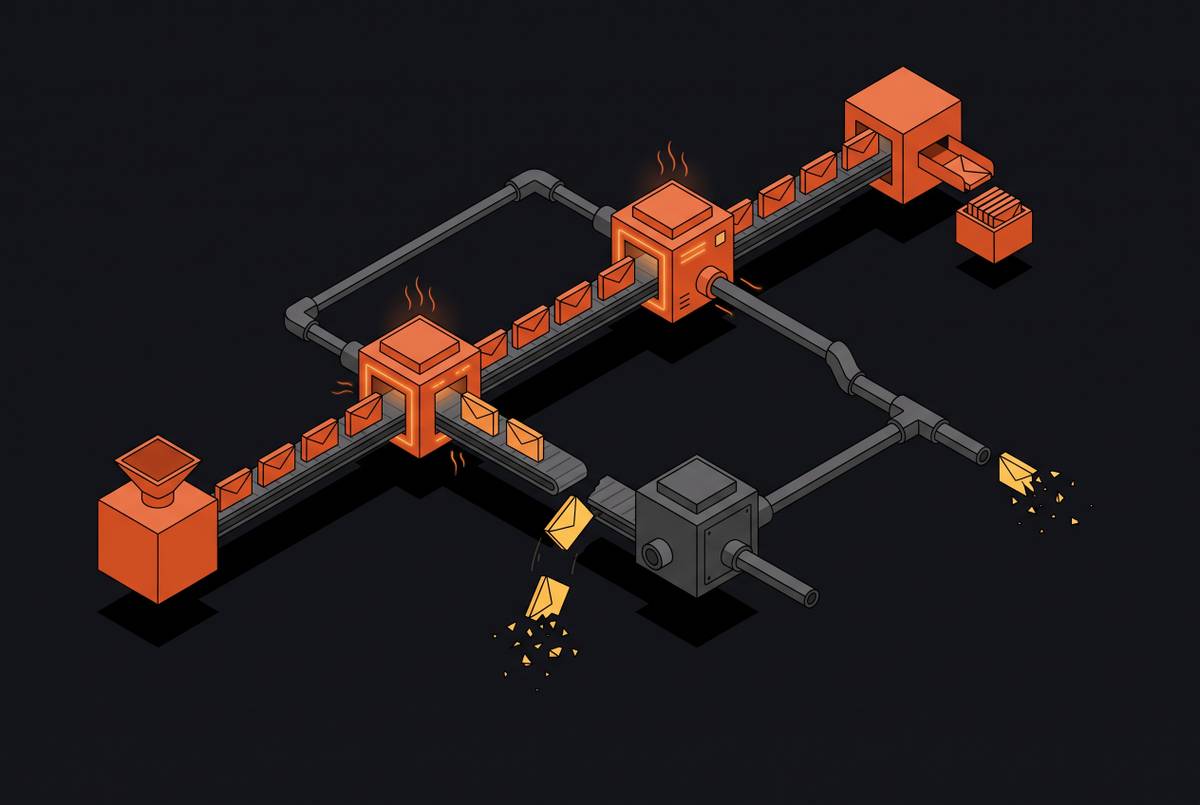
A unified transactional and marketing email API for AI applications should let agents send receipts, newsletters, and lifecycle messages through the same platform. The agent declares intent, while the platform handles stream assignment, suppression, reputation isolation, and validation. Sending decisions belong in the agent, but routing and state-sync plumbing belong below it.
Why agents make the routing problem worse, not just different
Email infrastructure was designed around a human who reads failures. Agents retry, following the logic available to them without the ambient awareness that helps a person interrupt a bad send. A human notices a template variable appearing as literal text, recognizes the wrong recipient list, or pauses before sending at scale. An agent executes the workflow, including its gaps.
That mismatch becomes more dangerous when transactional and marketing sends use separate platforms. The agent must keep routing tables up to date, bring subscriber records into line, and merge suppression state before it can act reliably. None of this is business logic. Yet putting it in the decision loop turns a routing defect into a decision-layer defect that is harder to see and test, while autonomous execution spreads its effects.
Event-driven architectures make the classification step difficult to avoid. A product emits an event, and the agent must determine what email action follows. A billing alert is transactional, a win-back is marketing, and a lifecycle nudge triggered by inactivity sits between them. If each category belongs to a different service, interpretation also determines infrastructure.
What actually breaks when an agent routes across two systems
Suppression drift begins with state that only one platform knows. A subscriber opts out through a marketing email, but that decision is not automatically visible to the transactional service. The agent has no native, shared view of which addresses have asked not to be contacted. If it sends password resets through one API and newsletters through another, it cannot assume that applicable suppression decisions have reached both. The failure can go unnoticed because each service sees only its own record.
Transactional and marketing traffic need isolation because complaints from a high-volume campaign can damage the reputation used by critical messages. Password resets then face the consequences of an unrelated send. The agent cannot see that deterioration as it happens, so the first useful signal may be a deliverability drop. A routing error has now affected messages beyond the one that caused it.
Retry amplification adds a third failure category. Email infrastructure retries failed deliveries, so an agent endpoint can receive the same inbound event multiple times under normal conditions. Without a shared record of events that have been processed, each delivery can start another agent loop. Separate retry queues make duplication harder to recognize across providers. Each platform may report a single send while the recipient receives two or three.
The recommended sequence is domain verification and authentication records first, followed by one API key per send type with a budget and rate limit, then the least critical mail. That order treats routing as an operational boundary. Critical sends are not the first test of whether the boundary holds.
Why deliverability pressure on agents is structurally higher than on human senders
Agents need to establish the trust signals that human senders build up over time, including a warmed domain, a consistent behavioral fingerprint, and a natural limit on volume. Autonomy removes that last restraint. High speed and high volume make agents useful, but they also resemble the behavior abuse-detection systems are trained to punish. When traffic grows faster than the sending infrastructure can warm, filtering becomes an immediate risk.
A separate subdomain per send type, such as mail.yourapp.com for transactional messages and a different subdomain for agent-drafted autonomous sends, separates those reputation risks. Within one platform, infrastructure can enforce it, whereas separate providers leave the developer to maintain the boundary and the agent to respect it through routing logic.
CAN-SPAM, GDPR, and equivalent regulations apply to agent-sent email in the same way they apply to human-sent email. An audit trail must establish who initiated the send, what went out, to whom, when, why, and what happened after delivery. Routing cannot be separated from that accountability. When send history and consent state are split, the evidence needed to explain a decision is split too.
How one email API handles receipts and newsletters without switching platforms
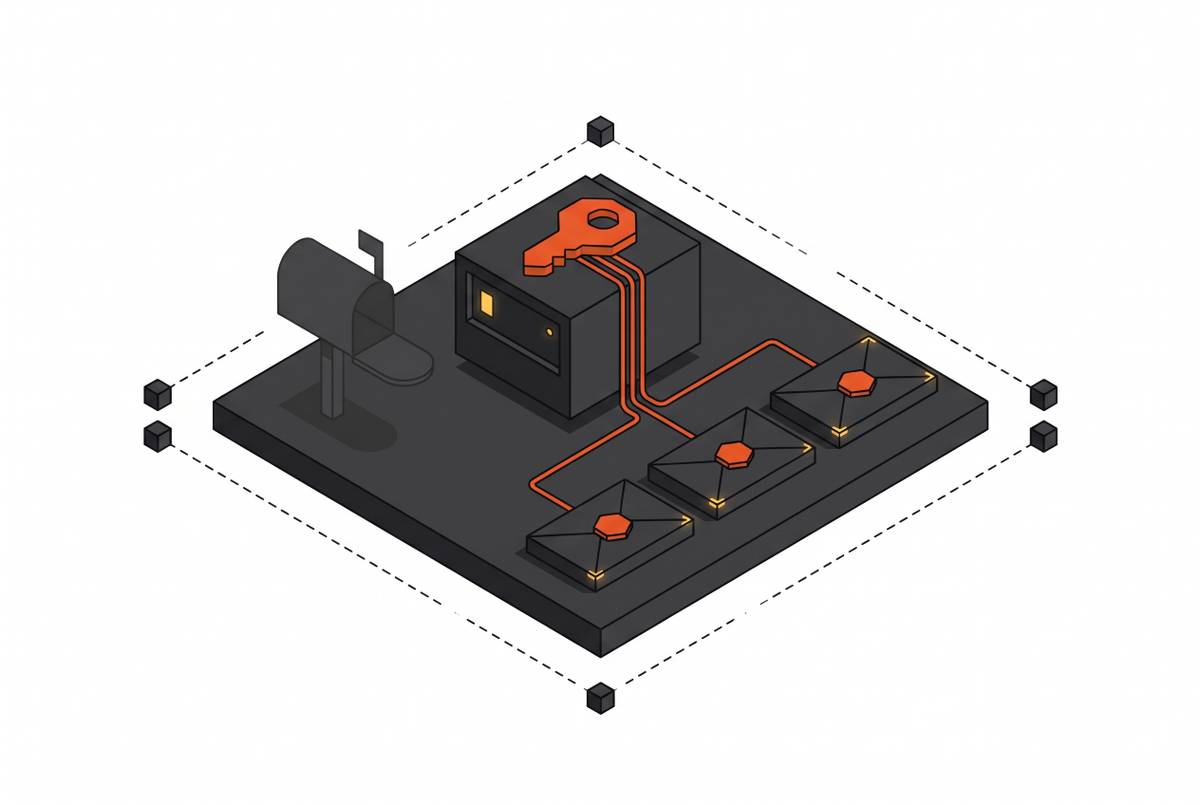
One record for each address can show suppression status, lifecycle stage, and recent sends across message types. The agent no longer queries two systems to assemble that context. Its decision concerns what the recipient should receive, rather than which provider has the most complete record.
Applicable unsubscribe and suppression state can be honored across streams without the agent copying changes between providers. This is more than a smaller call surface. It removes the interval in which one service knows that contact is restricted and another does not. The agent does not have to infer whether synchronization has finished before proceeding.
Reputation management moves into the platform without merging every send into one reputation pool. Transactional and marketing messages still need independent sending streams and reputations. One API must not mean one undifferentiated stream. The agent declares intent through a parameter or endpoint, and the platform assigns the stream. A billing alert that also contains an upsell no longer requires the agent to select a separate provider with different delivery consequences.
Delivery, engagement, and bounce data become available together, supporting the observe-orient-decide-act loop without polling separate services and merging their results. Pricing can remove another routing incentive. When billing is based on emails sent rather than contacts stored, doubling a list does not itself double the bill. The agent has less reason to add logic that routes messages to cut costs and has no bearing on the message’s purpose.
How MCP tooling changes the routing equation when it is designed for agents, not bolted on
An MCP server determines how much of that architecture reaches the agent. With typed, validated tools, the agent produces a structured function call, the server validates it, and the email operation executes. The agent need not construct a raw payload. When the schema covers both transactional and marketing operations, send intent becomes a tool parameter rather than a routing table maintained in the decision loop.
Partial coverage reverses that benefit. An MCP server that supports transactional sending but not marketing forces the agent to find another path for newsletters. A server that omits suppression management leaves related state outside the same contract. The wrapper has not removed the split. It has moved the point at which the agent encounters it, so completeness of the tool surface is an architectural criterion.
The NSA’s MCP Security Design Considerations states that idempotency “is not directly enforced by MCP” and is left to the underlying JSON-RPC and message queue specifications. The presence of an MCP server therefore does not establish that duplicate event delivery will produce only one action.
The infrastructure pattern is to store the message_id of each processed inbound event in a durable store, such as Redis or Postgres, and check it before initiating the agent loop. That check belongs outside the model’s reasoning. A platform that enforces idempotency at the API or MCP layer prevents duplicate events from triggering repeated actions at the execution boundary. Without it, the application must reconstruct shared state around its sending paths, bringing routing complexity back through retry handling.
Pre-send linting as the other half of the platform contract
Routing enforcement and pre-send validation make the same architectural argument about different failures. Routing keeps a message off the wrong infrastructure path, while validation blocks a payload that fails the rules before it can run. Neither is reliably enforced by a prompt. A model can skip, misread, or reason around an instruction, so the send boundary must reject payloads that fail its rules.
The silent failures are often ordinary defects. Unrendered variables such as {{first_name}}, missing unsubscribe links, broken personalization tags, localhost or staging links, and empty subject lines can all survive a successful API call. At agent speed, those defects can reach thousands of inboxes before a person notices, while the agent reports that the send worked.
A pre-send linting layer intercepts every send and checks it against a defined rule set. On failure, it stops the operation and returns a machine-readable error with a specific fix. That response creates a usable correction path. The agent can act on the structured error in its next iteration without having to own the validation rules itself. As with routing, the platform enforces the boundary and returns information the agent can use.
The operational progression begins with read-only access and a human review gate, then moves through draft creation, test sends to small segments, supervised production sends, and autonomous operation. Permissions expand as reliability is demonstrated. The basis for that expansion is not confidence in the model alone, but evidence that the platform catches failures the model would miss.
What purpose-built agentic email infrastructure looks like in practice
A retrofitted MCP wrapper exposes existing operations, while purpose-built infrastructure is organized around the risks of an autonomous sender. The distinction is where enforcement lives. A platform can offer convenient tools and still leave stream selection, suppression reconciliation, and validation to the agent. AgentSend’s place in this architecture is as the answer to that broader infrastructure problem.
For purpose-built agentic email infrastructure, the substantive standard is the complete platform contract. It includes transactional, broadcast, and lifecycle sends through one API, with compliance defaults such as unsubscribe headers and suppression lists enabled by default. Declared intent must lead to platform-managed stream assignment and reputation isolation. The contract must also include pre-send checks and controls on when permissions can expand. These are the capabilities that would justify autonomous access, rather than the presence of an agent-facing interface alone.
Mailtrap approaches the workflow from a deliverability-first position. Its offering includes an official MCP server, an agent skill, a CLI, separate bulk and transactional sending streams, and a sandbox testing environment. It also runs the deliverability infrastructure, so the developer does not have to handle domain warming and reputation management. Those features address distinct operational needs. Its stream separation keeps sends within their routing boundaries, and the sandbox lets them be tested before production sends.
Postmark illustrates the stream-isolation part of the contract. Its message streams architecture keeps send types apart, each with its own analytics and reputation, so an agent can send to a named stream while the platform protects transactional reputation from marketing complaints. That is a concrete infrastructure guarantee. Microsoft Dynamics 365 Customer Insights covers another part with MCP tool calls that let an agent check consent, get an unsubscribe link, and put it in the outbound message.
The decisive test is whether an agent can receive access to a sending domain without a human reviewing every send, and whether the platform can guarantee that nothing malformed, non-compliant, or misdirected reaches a recipient. Both conditions must hold for autonomous operation. A unified endpoint alone does not answer the question, and neither does an MCP wrapper. The answer depends on whether routing, shared state, idempotency, and validation are enforced below the agent’s decision loop.